Navigating the history, guest legacies, and sartorial expectations of the world’s most fiercely protected hospitality institutions.
In an era where mass-market hospitality has largely surrendered to hyper-casualization, a select cadre of heritage hotels refuses to compromise. For ultra-high-net-worth (UHNW) principals, these institutions provide a curated, theatrical environment where the aesthetic standards of the clientele match the architectural grandeur of the property.
A strict dress code is an architectural boundary that preserves the atmosphere, history, and sovereign exclusivity of the space. Below is an intelligence briefing on the history, guest profiles, and sartorial requirements of seven of the world's most uncompromising luxury enclaves.
1. The Ritz Paris (France)
The Property & Atmosphere: Inaugurated on June 1, 1898, by visionary hotelier César Ritz and legendary chef Auguste Escoffier, The Ritz Paris set the blueprint for modern luxury hospitality. Located on the historic Place Vendôme, the former 18th-century townhouses were transformed into a palace of unprecedented opulence, featuring private en-suite bathrooms, electricity, and custom brass fixtures designed by Marie-Louise Ritz. The interior remains a triumph of French Neoclassical design, housing the renowned Bar Hemingway, fine dining salons, and lavishly restored suites.
History & Famous Guests: The hotel’s history is intimately bound with the cultural elite of the 20th century. Coco Chanel made the Ritz her personal home for 34 years, Marcel Proust wrote sections of In Search of Lost Time in its lounges, and Ernest Hemingway famously declared he "liberated" the hotel’s bar at the end of World War II. Its halls have welcomed everyone from F. Scott Fitzgerald and Cole Porter to modern icons such as Madonna, Rihanna, and Anna Wintour.
The Sartorial Standard: Elegance is a structural requirement. In the public areas, the Bar Hemingway, and the Michelin-starred dining rooms, sportswear, shorts, and athletic sneakers are strictly forbidden. While formal neckties are optional, gentlemen are expected to wear tailored suit jackets after 6:00 PM to maintain Paris’s most refined visual environment.
2. Sandy Lane (Barbados)
The Property & Atmosphere: Set along the platinum west coast of Barbados, Sandy Lane opened in 1961 on a former sugar plantation. Following a massive $280 million total reconstruction in the late 1990s, the resort re-emerged as the undisputed sanctuary for international wealth in the Caribbean. Built from pristine white coral stone and surrounded by mahogany trees, the property features a 47,000-square-foot luxury spa and three world-class golf courses, including the ultra-exclusive Green Monkey course.
History & Famous Guests: Since its inception, Sandy Lane was engineered with total celebrity and diplomatic privacy in mind. Early decades saw frequent stays by Frank Sinatra, Mick Jagger, and European aristocracy. In modern times, it remains the private winter hideaway for global titans, high-profile athletes, and entertainment icons—famously hosting Tiger Woods' private wedding in 2004 and serving as a quiet base for British royals and business moguls.
The Sartorial Standard: Beyond the national Barbadian law prohibiting military-style camouflage clothing, Sandy Lane operates under rigid dress standards. Swimwear is restricted strictly to the beach and pool areas. For evening dining at L'Acajou, gentlemen must wear long tailored trousers and collared shirts; t-shirts, shorts, and open-toed sandals are strictly prohibited.
3. Hôtel de Paris Monte-Carlo (Monaco)
The Property & Atmosphere: Opened in 1864 under the direction of François Blanc, the Hôtel de Paris Monte-Carlo was designed to transform a quiet Monegasque headland into Europe's premier gaming and luxury resort. Sitting directly adjacent to the Place du Casino, the Belle Époque landmark features lavish gilded frescoes, marble colonnades, and the legendary 3-Michelin-starred Le Louis XV by Alain Ducasse. Beneath the hotel lies its world-renowned wine cellar, opened in 1874, housing over 350,000 rare bottles.
History & Famous Guests: The hotel’s ledger reflects the history of European royalty and Hollywood royalty alike. Sir Winston Churchill maintained his own top-floor suite, while Sarah Bernhardt, Charlie Chaplin, Salvador Dalí, and Frank Sinatra were regular patrons. It famously served as the backdrop for Princess Grace Kelly and Prince Rainier III’s wedding celebrations, and today hosts heads of state, Formula 1 drivers, and sovereign family office leaders.
The Sartorial Standard: Serving as the backdrop to Monaco’s high-stakes lifestyle, dress codes are strictly policed. At Le Louis XV - Alain Ducasse, tailored evening suits and jackets are required for gentlemen. Casual denim, athleticwear, and casual shoes are rejected at the entrance to preserve the room's aristocratic atmosphere.
4. Villa d'Este, Lake Como (Italy)
The Property & Atmosphere: Originally constructed in 1568 as a summer residence for Cardinal Tolomeo Gallio, Villa d'Este is an architectural masterpiece of the Italian Renaissance. Converted into a luxury hotel in 1873, the 25-acre estate features manicured Renaissance gardens, a famous floating pool on Lake Como, and historic mosaic nymphaeums. The property offers unmatched waterfront isolation framed by snow-capped alpine foothills.
History & Famous Guests: The estate’s history includes ownership by Caroline of Brunswick, Princess of Wales, before becoming a playground for high society. Alfred Hitchcock shot his first feature film here, while Elizabeth Taylor, Conrad Hilton, Clark Gable, Frank Sinatra, and the Duke and Duchess of Windsor frequented its private villas. Modern regular guests and diners include George and Amal Clooney alongside international political leaders attending the annual Ambrosetti Forum.
The Sartorial Standard: In keeping with Renaissance grandeur, dress standards shift dramatically at dusk. After 6:00 PM, jacket wearing is mandatory for gentlemen dining at The Veranda restaurant. T-shirts, shorts, and casual footwear are prohibited across all main indoor evening venues.
5. Raffles Singapore
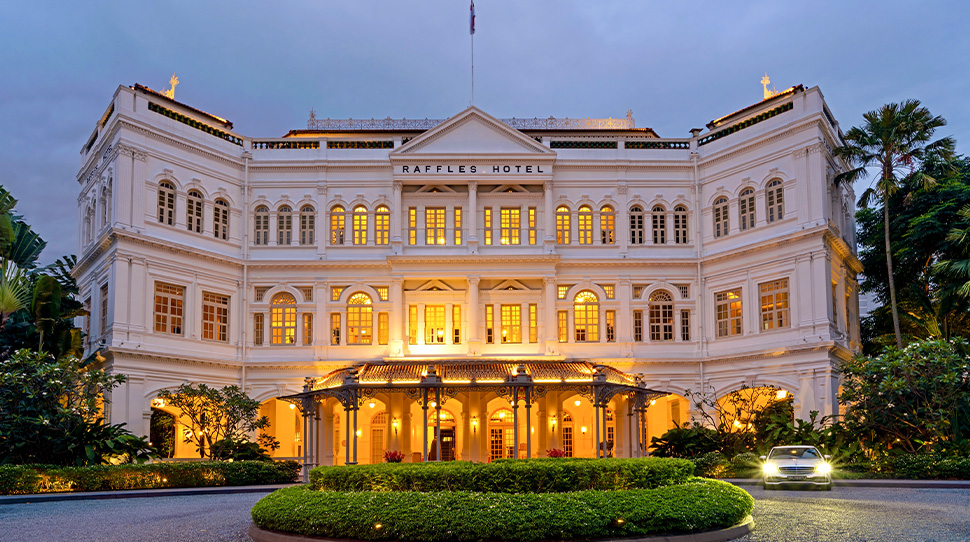
The Property & Atmosphere: Founded by the Sarkies Brothers in 1887, Raffles Singapore is an iconic colonial-style hotel named after Singapore's founder, Sir Stamford Raffles. Featuring white teak verandas, lush tropical courtyards, and classical Victorian architecture, the hotel represents the golden age of Asian travel. It is also the birthplace of the national cocktail, the Singapore Sling, created in 1915 at its famous Long Bar.
History & Famous Guests: Legendary literary figures made Raffles their eastern base, including Rudyard Kipling, Somerset Maugham, Joseph Conrad, and Ernest Hemingway. The hotel has welcomed global dignitaries ranging from Queen Elizabeth II to Charlie Chaplin, Elizabeth Taylor, and the Prince and Princess of Wales (William and Kate). It is also famous for local lore, including the story of the last wild tiger in Singapore hunted beneath the Bar & Billiard Room in 1902.
The Sartorial Standard: The hotel balances tropical equatorial heat with strict colonial formality. While the casual Long Bar permits daytime tourist wear, signature dining institutions like La Dame de Pic and the Tiffin Room require "Casual Elegance." Shorts, athletic tank tops, pool attire, and open sandals for men are prohibited.
6. Reid's Palace, A Belmond Hotel, Madeira (Portugal)
The Property & Atmosphere: Perched atop sub-tropical cliffs overlooking the Atlantic Ocean in Funchal, Reid's Palace was established in 1891 by Scotsman William Reid. Set within ten acres of botanical gardens featuring rare orchids and palms, this Belmond property is famous for its sea-water swimming pools and its daily Afternoon Tea ritual served high on the cliffside terrace.
History & Famous Guests: Sir Winston Churchill famously retired to Reid’s Palace in 1950 to paint and write his war memoirs. European royalty, literary figures like George Bernard Shaw (who learned to tango on the terrace), and John le Carré were regular visitors. The property was even immortalized in James Bond lore by author John Gardner in the 1981 continuation novel Icebreaker.
The Sartorial Standard: Reid's preserves traditional British seaside formality. Smart casual attire is mandatory for the famous Afternoon Tea service. In the evening at the Michelin-starred William Restaurant, gentlemen must wear long trousers and elegant closed shoes, with tailored sports coats or suits strongly preferred.
7. Rambagh Palace, Jaipur (India)
The Sartorial Standard & History: Originally constructed in 1835 as a royal garden house, Rambagh Palace expanded into a hunting lodge and eventually became the principal residence of the Maharaja of Jaipur, Sawai Man Singh II, and Maharani Gayatri Devi. Managed by Taj Hotels, the "Jewel of Jaipur" spans 47 acres of Mughal gardens featuring hand-carved marble jalis, sandstone corridors, and gilded banquet halls.
Famous Guests: Over the past century, the palace has hosted international heads of state and royal figures including Lord Louis Mountbatten, Prince Charles (now King Charles III), Princess Diana, Jacqueline Kennedy, and Queen Elizabeth II. It remains the primary destination for visiting heads of state, sovereign investors, and global celebrities touring Rajasthan.
The Sartorial Standard: Operating with palatial dignity, dining in the Suvarna Mahal—the original royal banquet hall featuring Italian frescoes and gilded mirrors—requires formal evening attire. Gentlemen are expected in collared shirts, suit jackets, and closed dress shoes. Casual shorts, sportswear, and flip-flops are strictly disallowed in evening venues.
The APX Private Network Takeaway
For the UHNW traveler, a strict dress code is not a restriction; it is an assurance of environmental quality. It guarantees that the visual and atmospheric integrity of a heritage property remains uncompromised. APX Lifestyle Concierge assists family offices in securing preferential suites, coordinating bespoke travel wardrobes, and managing private dining reservations at these highly guarded global enclaves.