A practical UHNW guide to superyacht cyber risk across bridge systems, guest networks, crew devices, communications, suppliers and the family office.
Executive Summary
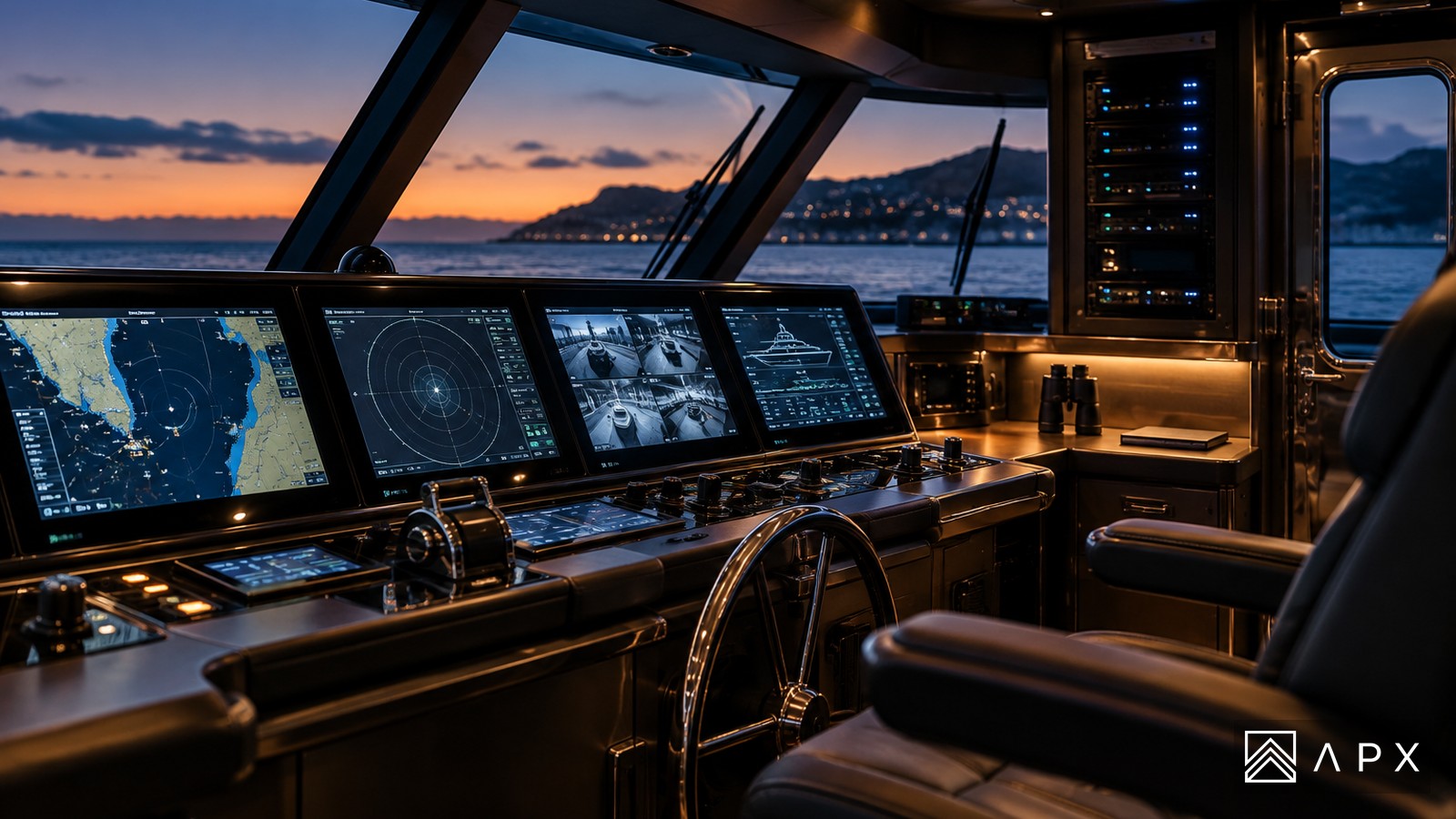
A modern superyacht is both a luxury residence and a connected industrial system. Navigation, communications, propulsion monitoring, access control, audiovisual networks, guest Wi-Fi, crew devices and shoreside management platforms can all exchange data. That connectivity creates convenience, but it also creates a cyber-risk surface that extends far beyond the bridge.
For UHNW owners, the most important point is that yacht cybersecurity is not simply an IT issue. A compromised system can affect privacy, safety, operations and the family office itself. The International Maritime Organization defines maritime cyber risk in terms of technology failures that may result in operational, safety or security failures, and its current guidance calls for a structured cycle of identifying, protecting, detecting, responding and recovering.
Key Takeaways
- Treat the yacht as part of the family’s digital estate. Guest information, itineraries and communications can be as sensitive as onboard control systems.
- Separate operational technology from guest convenience. Bridge, engineering and safety systems should not depend on the same trust assumptions as entertainment and personal devices.
- Crew behaviour matters. Phishing, unmanaged devices, shared credentials and weak vendor access can undermine otherwise sophisticated technology.
- Shore-side providers are part of the perimeter. Management companies, AV contractors, satellite providers and remote support teams require governance.
- Incident response must work at sea. The yacht needs offline contacts, authority levels and recovery procedures when normal communications are unavailable.
Why Yacht Cyber Risk Is Different
A large yacht combines systems that would normally sit in separate environments: a residence, hotel, office, communications hub and ship. That convergence makes the consequences of a cyber incident unusually broad. A breach of a guest network may expose private communications; interference with operational systems can affect navigation or engineering; compromised credentials may allow attackers to follow the owner’s movements or target the family office ashore.
The IMO’s revised Guidelines on Maritime Cyber Risk Management provide the baseline framework for cyber resilience in shipping. Separately, the International Association of Classification Societies introduced revised Unified Requirements E26 and E27 for cyber resilience of ships and onboard systems, applying to relevant new ships contracted for construction on or after 1 July 2024.
1. Map the Systems Before Buying More Security
The first step is an inventory. Owners should know which systems are connected, which can be reached remotely, which rely on satellite or cellular links and which vendors retain administrative access. That includes bridge and engineering systems, CCTV, access control, smart-cabin systems, AV, telephony, internet gateways and crew administration.
The useful question is not simply “is this system secure?” but “what can it reach if it is compromised?” Network segmentation should prevent a weak guest device or entertainment system becoming an easy route into operational technology.
2. Protect the Owner’s Privacy as Seriously as the Vessel
Itineraries, guest lists, passport data, medical requirements, preferences, provisioning records and real-time location data can all have value to an attacker. The cyber plan should therefore cover information held by crew and vendors as well as the vessel’s technical infrastructure.
APX has previously examined the wider operational implications of superyacht registration and charter compliance. Cybersecurity belongs in the same governance conversation because the owner’s risk travels across flag, management, crew and service-provider relationships.
3. Segment Guest, Crew and Operational Networks
Guests reasonably expect frictionless connectivity, but convenience networks should be designed with containment in mind. Separate SSIDs, VLANs and access policies can reduce the chance that a compromised phone, laptop or IoT device reaches sensitive systems. Crew administration should also be separated from guest traffic, with privileged accounts restricted to named individuals.
4. Control Remote Vendor Access
Modern yachts often rely on shore-based specialists for diagnostics, software updates and AV support. Remote access can be essential, but persistent vendor credentials create risk. Access should be time-limited where possible, protected with strong multi-factor authentication, logged and reviewed after major maintenance periods.
5. Make Crew Cyber Awareness Practical
Training should focus on scenarios the crew actually encounters: urgent invoice changes, fake messages from a principal, malicious QR codes, suspicious USB devices, travel-document requests and vendors asking for remote access. A technically secure yacht can still be compromised if an attacker persuades the right person to bypass the controls.
6. Build a Yacht-Specific Incident Plan
An incident at sea creates different constraints from an office breach. The captain, management company, cyber specialist, insurer, flag advisers and family office need clear lines of authority. Offline contact details, clean backup devices and documented recovery priorities matter if normal email or onboard systems cannot be trusted.
7. Test Recovery, Not Just Prevention
Backups should be segmented from the systems they protect and recovery procedures should be tested. Owners should know how rapidly navigation support, communications, access control and key guest services can be restored after a failure or compromise.
APX Perspective
The strongest yacht cyber programme is one the captain, technical team and family office understand together. Technology alone cannot solve a fragmented operating model. Owners should insist on visibility over systems, vendors, privileges and incident authority — and review that map after every significant refit, systems upgrade or change of management company.
Related APX Intelligence
Sources & Further Reading
APX Intelligence is provided for general informational purposes only. It does not constitute maritime, cybersecurity, legal, insurance or technical advice. Yacht owners and managers should obtain advice appropriate to the vessel, flag, class and operating profile.