
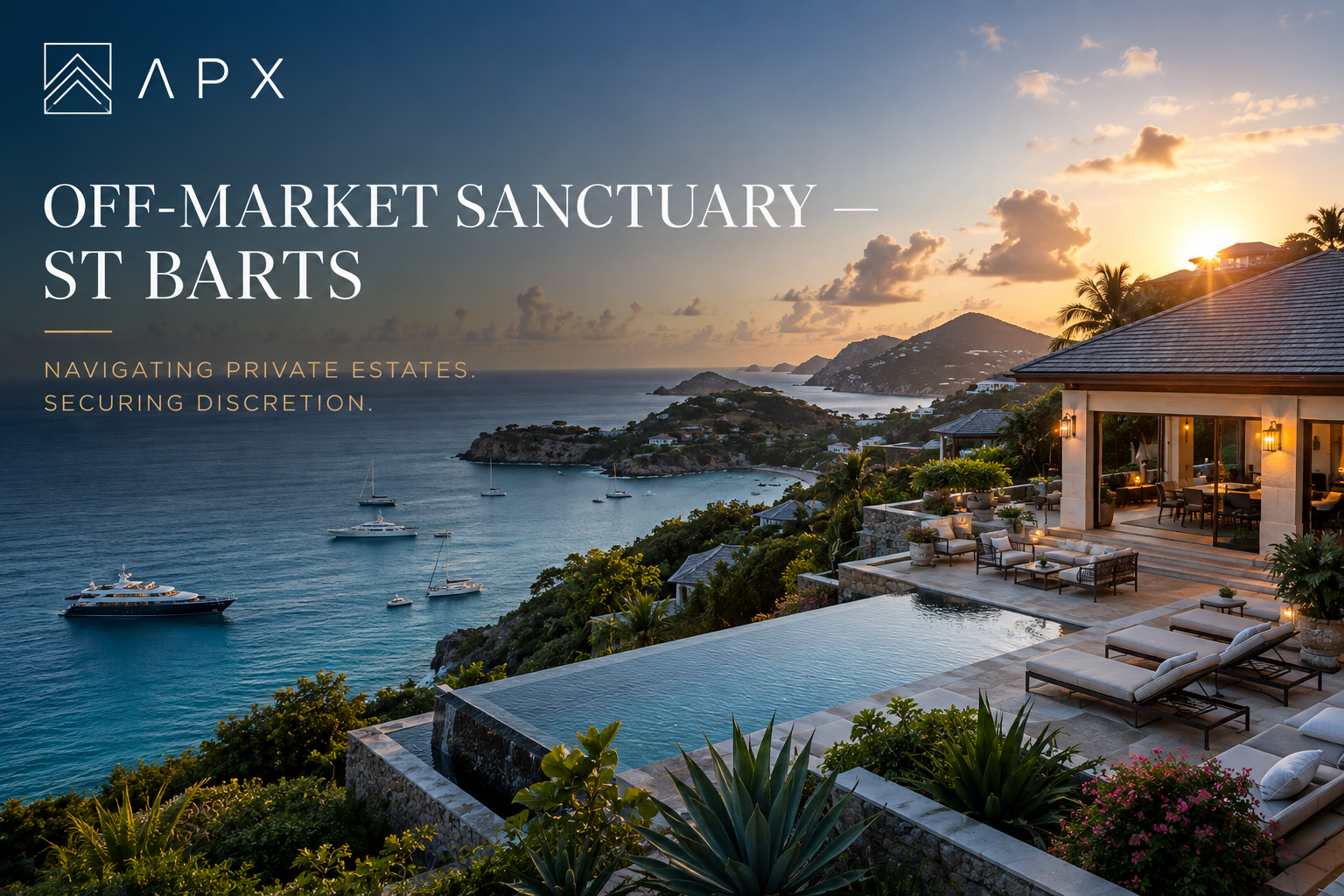
Off-Market Sanctuary: Ultra-Luxury Estate Rentals in St Barts
Navigating private cliffside compounds, discreet beachfront villas and stealth luxury across the Caribbean’s most exclusive island enclave
Executive Summary
There are Caribbean destinations that sell sunshine.
And there are destinations that sell privacy, control and social selectivity.
St Barts belongs emphatically to the second category.
Saint Barthélemy has long occupied a distinctive place in the UHNW travel landscape. It is glamorous but rarely showy, social but highly controlled, and luxurious without needing to rely on the scale or overt theatre associated with larger island resorts. For many affluent travellers, that balance is precisely the attraction.
But the most valuable layer of St Barts is not always found in the hotel market.
It sits in the island’s ecosystem of private villas, cliffside compounds, beachfront estates and discreet rental holdings, many of which are managed quietly, circulated selectively or released only through trusted advisers, villa specialists and established networks.
That is what makes St Barts especially relevant to APX members.
At the top end of the market, accessing the right property is not simply a matter of searching dates on a booking platform. It is about understanding micro-location, privacy architecture, staffing standards, yacht logistics, festive-period allocation, and whether the most suitable house is even being publicly offered at all.
Some travellers want immediate beach access and a fully staffed household.
Others want a hillside estate with deep privacy, sunset views and room for assistants, nannies, chefs or security personnel.
Some arrive by air and remain villa-based.
Others arrive by yacht and need a property that integrates seamlessly with tender transfers, harbour proximity or a wider Caribbean itinerary.
In each case, the headline question is not merely: “What is available in St Barts?”
It is: “What kind of St Barts experience is actually being sought — and what level of access is required to secure it?”
That is where destination intelligence becomes more useful than inventory.
Key Takeaways
- St Barts remains one of the Caribbean’s most desirable destinations for ultra-private villa stays, particularly for UHNW families, principals, founders and family offices seeking discreet luxury.
- The island’s most desirable rental homes range from beachfront villas to multi-structure hillside compounds with extensive staffing and security.
- The best-known villa zones are not interchangeable; Gouverneur, Flamands, Lorient, Gustavia and Pointe Milou all deliver different forms of privacy and lifestyle.
- At the highest level, villa rental value is shaped less by bedroom count than by location, privacy, staffing, service quality, architecture, and social positioning.
- Some of the most desirable festive and peak-season allocations may circulate privately rather than appearing widely on public booking portals.
- For many UHNW visitors, yacht access, harbour proximity, or discreet logistical support can matter as much as the villa itself.
- St Barts works best when approached as a micro-market of distinct enclaves, not a single generic luxury destination.
- The real premium in St Barts is often not square footage alone, but controlled access, discretion and execution.
Why St Barts Continues to Matter
Luxury islands rise and fall in profile. A new resort opens elsewhere, another destination becomes fashionable, or a different coastline captures social attention for a season.
Yet St Barts retains an unusual hold on the upper tier of Caribbean travel because its appeal is not built solely on beaches or hospitality. It is built on curation.
The island is relatively small, supply is finite, and development remains constrained compared with many competing destinations. The social identity of the island — chic, low-rise, cosmopolitan, French-influenced and villa-led — has remained unusually coherent.
That coherence matters. For UHNW travellers, the most valuable destinations are often those where the environment itself filters the guest profile. St Barts tends to do exactly that.
It is not merely a place to take a winter holiday. It is a place where a certain kind of traveller already understands the code: private villa rather than obvious spectacle, serious restaurants rather than all-inclusive resort culture, a strong preference for independence, and a high tolerance for discretion. That is why the island continues to command such loyalty.
The Real St Barts Market Is the Villa Market
Hotels play an important role in the island’s profile, but for many experienced high-net-worth travellers, St Barts is first and foremost a villa destination.
That distinction is crucial.
A hotel stay offers ease, structure and service on demand. A villa stay offers something different: space, control, privacy, household rhythm, private staffing, the ability to host, and, for many people, a much greater sense of actually inhabiting the island.
This is especially relevant for:
- multigenerational families;
- couples travelling with staff;
- individuals requiring close protection;
- groups arriving by yacht;
- principals entertaining privately;
- guests staying for several weeks rather than several nights.
At that level, a villa is not simply accommodation. It becomes temporary private infrastructure.
Meals happen when the household wants them. Security can be managed more discreetly. Children move more freely. Guests can arrive and depart without navigating a public hotel environment. And the stay begins to feel less like “being at a resort” and more like “living in St Barts for a period of time”.
That is a meaningful shift.
Understanding the Island by Micro-Market
One reason St Barts is frequently misunderstood by outsiders is that it is often discussed as though it were one seamless luxury zone. It is not.
The island’s villa market is better understood as a collection of micro-enclaves, each with its own character, privacy profile and social logic.
Gouverneur
For many villa specialists, Gouverneur sits near the top of the privacy hierarchy. The area is associated with some of the island’s most discreet hillside estates and larger compounds, often positioned to capture sea views while remaining relatively protected from casual visibility. It appeals strongly to travellers who want separation from heavier movement and social proximity without feeling remote.
This is the sort of St Barts that feels quietly formidable rather than obviously glamorous. The appeal lies in scale, space and control.
Flamands
Flamands offers a different kind of desirability. It is one of the island’s most admired beach settings and is especially attractive to travellers who want proximity to the sand without giving up private-villa living. Beachfront or near-beach properties here can carry a particular premium because they combine one of the most straightforward forms of Caribbean luxury — direct beach access — with St Barts’ highly limited supply.
For families, Flamands is often especially attractive because it offers both beauty and practicality.
Lorient
Lorient can offer a useful blend of residential calm and beach access. It is often less overtly “scene-driven” than some other parts of the island and can appeal to repeat visitors who value familiarity, surfing proximity, or a slightly more relaxed rhythm while remaining firmly within the island’s luxury ecosystem.
For some renters, Lorient feels more lived-in and less performative. That can be a virtue.
Gustavia Heights / Harbour Proximity
The Gustavia area occupies a very different position in the island hierarchy. For visitors arriving by yacht, prioritising restaurants, boutiques or harbour access, proximity to Gustavia can be strategically useful. Elevated villas above the harbour can offer panoramic views while preserving relative privacy and keeping the principal close to the social and logistical centre of the island.
This is particularly relevant for owners and charter guests moving between yacht and land-based hospitality.
Pointe Milou and Other Elevated Enclaves
Areas such as Pointe Milou appeal to travellers who value dramatic elevation, sunset exposure and a more architectural, view-led experience. These villas often trade direct beach adjacency for atmosphere and outlook.
That trade can be entirely rational. A traveller spending most of the day at their own pool, entertaining privately and dining out selectively may care far more about sunset, privacy and internal flow than about stepping straight onto sand.
Not All “Ultra-Luxury” Villas Are the Same
At the top end of the Caribbean rental market, the term luxury villa becomes too broad to be useful. A seven-bedroom house can be impressive, but that does not make it an UHNW-grade private estate.
What tends to separate an ordinary high-end rental from a true top-tier St Barts compound is not just size, but operational quality. That can include:
- a genuinely private approach and perimeter;
- architecture that supports discretion;
- guest and staff circulation that works smoothly;
- high-grade outdoor entertaining areas;
- strong bedroom separation;
- staff quarters or service zones;
- a professional kitchen setup;
- robust communications and AV;
- parking and arrival management;
- and, in some cases, suitability for private security.
The best villas also tend to be coherent. The interiors, staffing model, privacy design and owner expectations all align. In other words, the house feels as though it understands who it is for. That is often more important than another bedroom or another terrace.
What the UHNW Traveller Is Really Paying For
At first glance, top-end villa pricing can appear irrationally high. But in reality, the cost is rarely just about real estate.
An UHNW traveller renting a St Barts estate is typically paying for a combination of:
- Scarcity: There are only so many elite villas in the right locations.
- Privacy: True discretion has value, especially in a socially visible destination.
- Timing: Festive-season inventory is a different market from standard winter inventory.
- Service quality: A beautiful house with poor execution is not a top-tier asset.
- Social positioning: Some addresses carry meaning beyond their square footage.
- Logistical ease: For principals travelling with staff, children, guests or protection teams, frictionless execution matters.
At that level, the villa is doing much more than providing somewhere to sleep. It is supporting a very specific way of travelling.
The Cliffside Compound Appeal
One of the defining St Barts formats is the hillside or cliffside compound. This is perhaps the purest expression of the island’s private-estate culture.
These compounds often offer:
- commanding sea views;
- limited visual exposure;
- multiple buildings or pavilions;
- strong separation between guest suites;
- outdoor living areas designed for entertaining;
- and the psychological benefit of being “above” the island rather than inside it.
For principals who do not need to be on the beach every moment, this can be the most compelling proposition. The experience becomes almost residential in the most elevated sense of the word: self-contained, atmospheric and decisively private.
It also suits the kind of guest who values presence over proximity. You are not necessarily steps from a restaurant or a beach club. You are occupying a piece of the island in a much more controlled way.
The Beachfront Estate Appeal
Beachfront villas solve a different problem. They reduce the distance between the house and the Caribbean itself to essentially zero.
That sounds simple, but at the top end it can be transformative. A strong beachfront house allows the guest to move effortlessly between breakfast terrace, pool, beach, lunch, afternoon swim, cocktails, and sunset.
For families, it can be particularly effective. For those who view St Barts primarily as a place to be on or beside the water, it is hard to beat.
But beachfront does not automatically mean better. Some beachfront homes have less privacy, some are more exposed to movement, and some sacrifice scale or separation. Again, the right answer depends on how the property will actually be used.
Gustavia, Yachts and the Land-Sea Lifestyle
One of St Barts’ defining advantages is the relationship between the villa market and the yachting world. The island works unusually well for travellers who divide their time between land-based privacy and maritime lifestyle.
For some, that means chartering a yacht while using the villa as a land base. For others, it means arriving aboard a yacht but wanting several nights of terrestrial stability and privacy. For others still, it means entertaining across both environments.
This is why harbour proximity, tender logistics and access to Gustavia can become highly relevant. A villa does not need a helipad or literal mooring rights to participate in this world. It does, however, need to fit into it.
For the right traveller, the most valuable house may not be the most remote or the most dramatic. It may be the one that allows a seamless relationship between harbour, dining, yacht, guests and private residence.
The Off-Market Reality
This is where the article becomes especially relevant to APX.
Not every high-value villa rental in St Barts is truly “off-market”. But equally, not every important opportunity is fully public. That distinction matters.
Some properties are listed openly across specialist villa agencies. Others are shared more selectively. Some circulate only with trusted brokers. Some are released only for particular dates. Some owners prefer discretion for security, privacy or reputational reasons. And during periods such as the festive season, long-established client relationships can matter as much as money.
This creates a two-speed market:
- The public market shows what is broadly available.
- The private market reveals what may be available if the right relationship, timing or introduction exists.
That is why the most useful question is often not: “What villas are online?” but: “What can be accessed that is not widely visible?”
Off-Market Does Not Mean Mythical
It is important not to romanticise the idea of off-market inventory. A property being private does not automatically make it superior.
Some public villas are better than some private ones. Some high-profile names are less well executed than quieter alternatives. And some “off-market” language can be used too loosely in luxury travel.
The real value of private-market access is not mystique. It is additional optionality. A client may gain access to:
- a better-located villa;
- a more suitable staffing setup;
- stronger privacy;
- specific festive-period availability;
- a house that is not photographed widely online;
- or a property owner willing to accommodate a more bespoke arrangement.
The principle is simple: better access does not guarantee a better outcome, but it improves the likelihood of finding the right one.
Festive Season Is Its Own Market
No serious St Barts discussion is complete without acknowledging the December–New Year reality. At that point, the island becomes its own luxury micro-economy.
Demand intensifies, supply tightens dramatically, guest profiles become even more selective, and villa allocations that may seem theoretically available in quieter months can become extraordinarily difficult to secure.
For repeat UHNW travellers, festive access is often determined by lead time, agency relationships, prior client history, flexibility on dates, willingness to take larger compounds, and, occasionally, quiet access to private inventory.
This is one of the clearest examples of why St Barts should not be approached as a standard luxury-holiday booking exercise. Peak-period allocation behaves much more like relationship-based access to a scarce asset.
Security, Staffing and Operational Fit
For many UHNW travellers, the quality of a villa is inseparable from the quality of its operational support. A beautiful property that cannot absorb the traveller’s real-world needs is not a high-grade solution.
That is particularly true where the stay involves children and nannies, personal assistants, private chefs, wellness staff, drivers, or protective security.
At this level, questions matter:
- Can the villa absorb additional staff discreetly?
- Is there a proper service flow?
- How secure is the approach road?
- How exposed is the house to neighbouring sightlines?
- Is the arrival experience suitable for a principal who values privacy?
- Can provisioning be handled smoothly?
- Is the villa set up for quiet, efficient hosting?
A top-tier estate should support those needs naturally. If it does not, the property may still be lovely — but it may not be suitable.
Renting the Right House vs Renting the Most Expensive House
One of the mistakes sometimes made in the UHNW rental market is equating price with fit. That is too simplistic.
A more expensive St Barts villa may be larger, more visible or more architecturally dramatic. That does not automatically make it the best choice.
- A lower-profile estate might better serve a family that wants privacy.
- A harbour-adjacent house might better suit a yacht-linked itinerary.
- A beachfront villa might be ideal for a family with young children.
- A compound with multiple pavilions might be better for guests travelling with staff and multiple generations.
The objective is not to find the most expensive house. It is to find the house whose privacy profile, service level, geography and internal logic best match the guest. That is a different exercise — and usually a better one.
St Barts Versus Other Caribbean Luxury Destinations
The reason St Barts continues to stand apart is not that it is the largest, most dramatic or most resort-heavy island in the Caribbean. It is that it has developed a distinctive luxury language.
Compared with larger Caribbean resort destinations, St Barts can feel:
- more edited;
- more design-conscious;
- more villa-oriented;
- more privacy-centric;
- and more socially selective.
It is not necessarily the best answer for every traveller. Someone wanting broad resort infrastructure, multiple golf courses or a very hotel-led family environment may be better served elsewhere.
But for travellers who want intimate scale, serious villas, strong food culture, yachting adjacency and a polished but discreet atmosphere, St Barts is difficult to replace.
What APX Members Should Ask Before Securing a St Barts Estate
At this level, the useful questions go well beyond price:
- What kind of privacy is actually required? Low visibility, guarded access, family privacy and celebrity-grade discretion are not identical needs.
- Is beach access essential? Some travellers imagine they want beachfront, but may use a hillside compound more effectively.
- Will the stay involve staff or security? If so, operational setup becomes crucial.
- Is the trip villa-led or yacht-linked? Harbour and tender logic may matter more than another sea-view terrace.
- Are restaurants and social access important? Some guests want seclusion. Others want proximity to Gustavia and island life.
- Is festive access the objective? If so, relationship-led access and lead time become central.
- Is the house merely beautiful — or does it function properly? This is often the decisive difference.
The APX Perspective
The old model of luxury travel was relatively simple: choose a destination, choose a resort, book the best suite.
At the UHNW level, St Barts illustrates why that framework increasingly breaks down.
The real asset is often not the room or the rate. It is access to the right environment, in the right location, with the right degree of privacy and the right operational support.
That is why St Barts works so well as an APX subject. On the surface, it is a glamorous island with beautiful villas. Beneath that, it is a small, highly stratified market where geography, relationships, service standards and discretion all determine value.
The most suitable property may not be publicly visible. The most expensive property may not be the best one. And the right answer for one principal may be entirely wrong for another.
For APX members, this is precisely where curated intelligence matters. The useful starting point is not: “What is St Barts’ best villa?” It is: “What kind of principal is travelling, what type of privacy is required, how do they intend to live while on the island, and what level of access is needed to secure the right estate?”
Answer those questions properly, and St Barts becomes much easier to navigate — not as a postcard destination, but as a private-enclave asset class within Caribbean leisure.
Frequently Asked Questions
Is St Barts a good destination for private villa rentals?
Yes. St Barts is widely regarded as one of the Caribbean’s strongest villa markets for affluent travellers seeking privacy, design-led accommodation and discreet high-end service.
Which areas are best for ultra-private villas in St Barts?
Gouverneur is often associated with strong privacy and prestigious hillside estates. Flamands appeals for beachfront access, while areas near Gustavia can be especially useful for harbour, dining and yacht proximity.
Are there off-market villas in St Barts?
Yes, although the phrase should be used carefully. Some desirable villas are circulated selectively or handled through trusted relationships rather than being widely advertised.
Is beachfront always better than hillside in St Barts?
Not necessarily. Beachfront offers immediate sand access, while hillside estates often provide greater privacy, stronger views and more compound-like living.
Why is St Barts especially popular with UHNW travellers?
Because it combines privacy, limited supply, strong villa culture, sophisticated dining, yachting relevance and a luxury atmosphere that is polished without being overly public.
Is St Barts mainly a hotel destination or a villa destination?
For many UHNW visitors, it is primarily a villa destination. Hotels matter, but private villas often deliver the privacy, control and household rhythm that affluent repeat travellers prefer.
Does festive season work differently from the rest of the year?
Very much so. Peak festive allocations can become significantly more constrained, and access may depend heavily on timing, relationships and the quality of the booking channel.
Is off-market automatically better?
No. The value of off-market access lies in broader choice and greater discretion, not in the assumption that every private listing is superior to public inventory.
Is St Barts especially useful for yacht-linked travel?
Yes. The relationship between villas, Gustavia and the yachting world is one of the island’s defining characteristics, making it particularly attractive for travellers combining land and sea logistics.
What is the biggest mistake when booking a St Barts estate?
Focusing too heavily on the headline property rather than whether the house genuinely fits the traveller’s privacy, staffing, social and logistical requirements.


