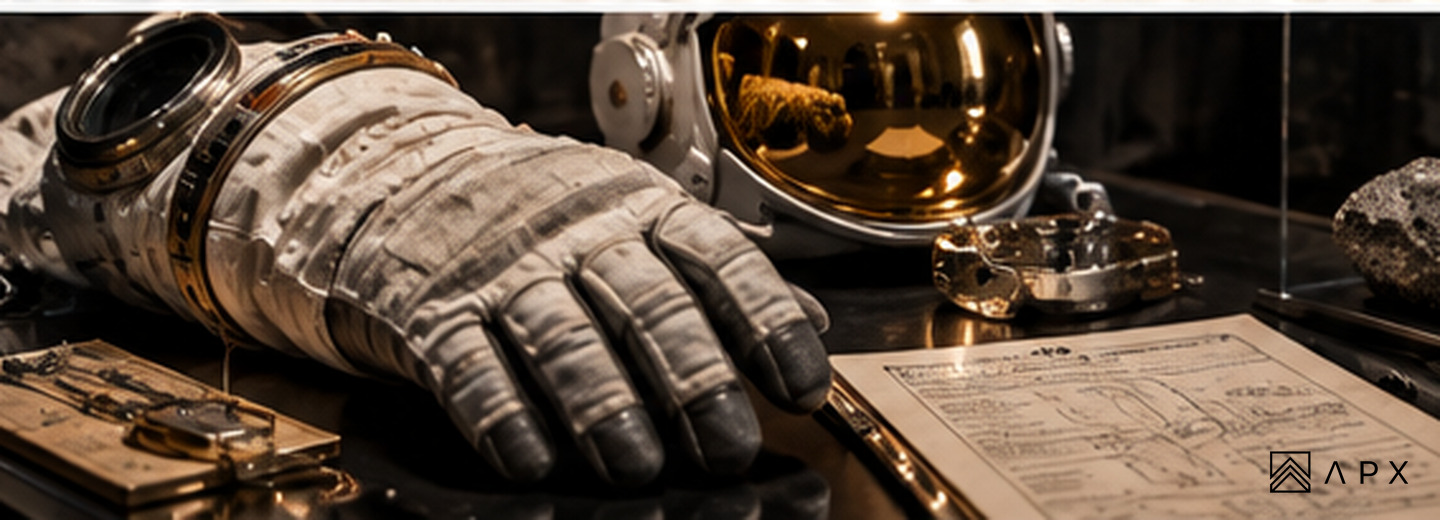
Apollo and Soviet space artefacts have reached multi-million-dollar prices. APX examines mission provenance, legal title, conservation and liquidity.
Executive Summary
Space memorabilia is one of the few collectible categories where an object can have both engineering significance and a documented role in a historic mission. Sotheby’s records include roughly $2.8 million for Buzz Aldrin’s Apollo 11 inflight coverall jacket, $2.88 million for a Vostok 3KA-2 spacecraft and $1.8125 million for the flown Apollo 11 lunar sample return bag. The market ranges from signed photographs to spacecraft hardware, but the trophy tier is defined by mission use and legal ownership.
For UHNW collectors, space material requires unusually careful title diligence. NASA, other governments and contractors retained ownership of vast amounts of equipment, and not every object that entered private hands did so lawfully. Export controls, cultural-property considerations and hazardous materials can also complicate transport and resale.
Key Takeaways
- Flown and astronaut-used material commands a major premium over generic signed memorabilia.
- Sotheby’s has recorded multi-million-dollar results for Apollo and Soviet space objects.
- Legal title is a first-order issue: government property cannot become collectible merely because it was discarded or retained informally.
- Mission documentation, serial numbers, photographs and astronaut provenance are essential.
- Conservation can be technically complex because historic hardware may contain degraded foams, batteries, lubricants or other materials.
What Makes Space Material Valuable?
Mission use
An object that flew on Apollo 11 occupies a different category from an identical spare that remained on Earth. The strongest premium attaches to direct participation in a defining mission, especially where flight manifests, photographs or astronaut records can prove use.
Human connection
Astronaut-worn equipment, personal checklists, annotated manuals and objects retained by crew members can combine technical and biographical provenance. That intersection can make a modest-looking item historically important.
Uniqueness
Complete spacecraft, lunar material and one-off engineering objects have obvious scarcity. But buyers should distinguish true uniqueness from marketing language; many mission artefacts were manufactured in multiples.
The Legal-Title Problem
Space collecting has a history of disputed ownership. Government agencies often retained title to equipment even when custody became informal. Before acquisition, buyers should trace deaccession, authorised gift, astronaut ownership, government sale or other lawful transfer.
For lunar material, meteorites and returned mission samples, ownership can be especially sensitive. A specialist lawyer should review title and any export or import restrictions before funds are transferred.
Custody and Display
Space artefacts invite display, but light, dust, humidity and physical support should be managed. Pressure suits, textiles and polymers may need conservation mounts. Large hardware can require structural engineering and specialist installation, while electronics should generally not be powered without technical assessment.
Market Structure and Liquidity
The buyer base is global but highly specialised. Important material tends to concentrate at established auction houses because scholarship and legal diligence are part of the product. Private sales are common as well, especially where owners value discretion, but that can make true clearing prices harder to observe.
Families building a space collection should maintain an object file for every acquisition, including ownership evidence, serial numbers, mission references, conservation records and high-resolution photographs. That documentation may be decisive when the collection is insured, loaned or eventually sold.
APX Perspective
Space memorabilia has a powerful narrative advantage: the best objects have an exact mission, date and function. That clarity makes them accessible to collectors outside aerospace. But the same government and scientific context that creates value also increases legal risk. For serious acquisitions, a clean title file is as important as the object itself.
Frequently Asked Questions
Is flown hardware always more valuable than an unused spare?
Usually, because mission use adds scarcity and historical relevance. The premium depends on the mission, documentation and the object's role.
Can private collectors own moon material?
Some documented lunar material has entered private ownership lawfully, but title is highly sensitive and should be independently verified.
What documents should accompany a major space artefact?
Mission records, serial-number references, provenance letters, photographs, prior auction catalogues and evidence of lawful private ownership are particularly important.
Related APX Intelligence
Sources & Further Reading
APX Intelligence is provided for general information only and does not constitute investment, legal, tax or financial advice. Collectibles and alternative assets can be illiquid, difficult to value and subject to material transaction, storage, insurance and authenticity risk.