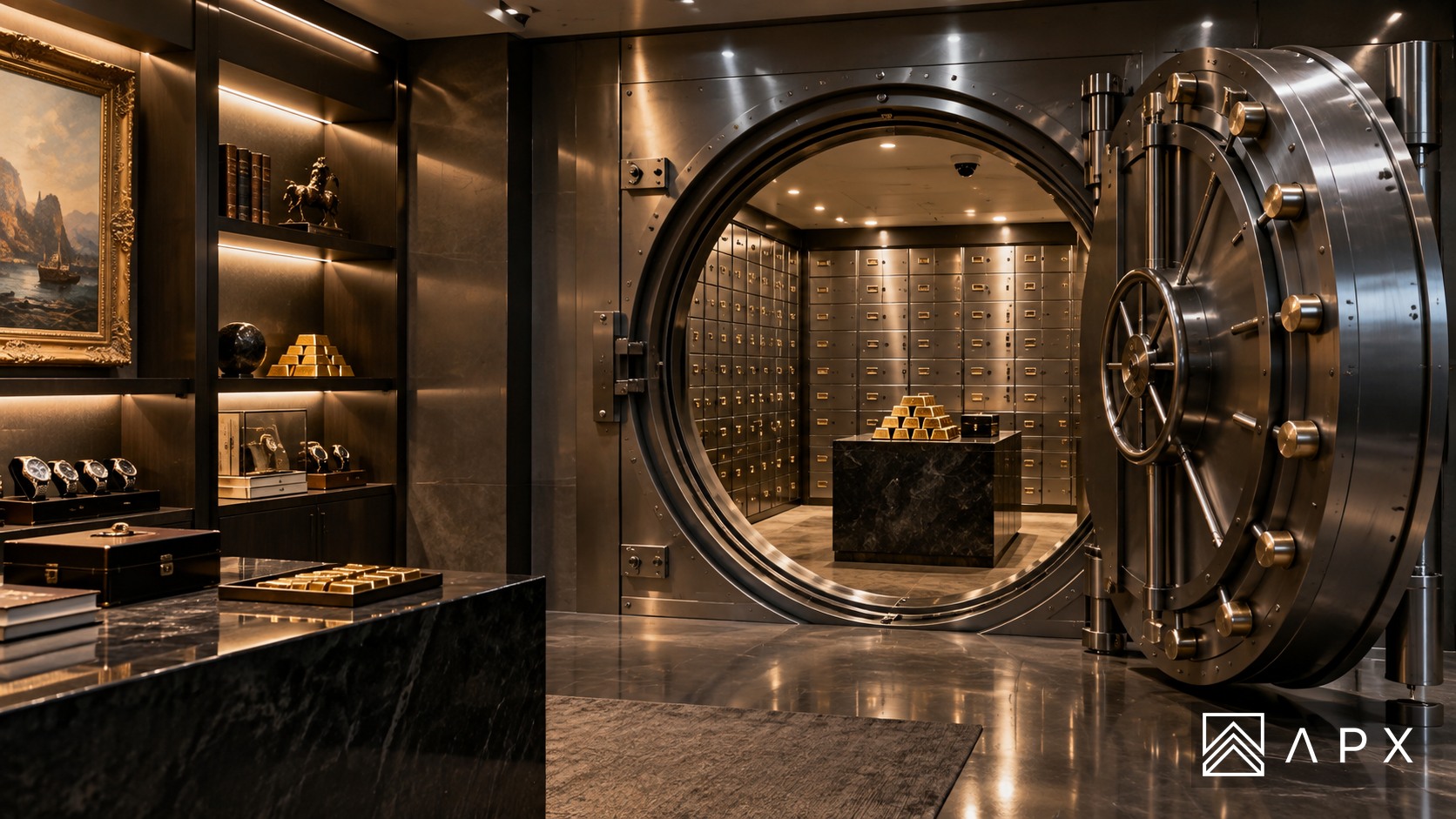
Bank box or specialist private vault? APX examines legal title, allocation, insurance, access, jurisdiction and custody controls for significant physical assets.
Executive Summary
For UHNW families holding bullion, jewellery, important documents or other portable stores of value, the phrase “safe deposit box” can hide a major structural distinction. A conventional bank box is primarily a secure place inside a banking relationship. A specialist private vault can be an independent custody arrangement with different access procedures, insurance structures, inventory controls, logistics and — depending on the asset — clearer evidence of title.
Neither model is automatically superior. The correct choice depends on what is being stored, how often it must be accessed, whether the owner requires individually identified assets, the jurisdiction involved and how the facility treats insurance, insolvency, reporting and release of property.
Key Takeaways
- Start with legal ownership, not the door thickness. Understand who owns the asset, who is custodian and what happens if the operator fails.
- For bullion, allocated and unallocated are fundamentally different. Individually identified metal is not the same as a general claim on an institution.
- Insurance must be explicit. Never assume a vault, bank box or transport arrangement automatically covers the full value.
- Access and logistics matter. A secure asset that cannot be efficiently released, inspected or transported may create operational friction at the worst time.
- Jurisdiction is part of the custody decision. Property rights, reporting, tax treatment and enforcement rules vary materially.
Bank Safe Deposit Box or Specialist Private Vault?
The comparison is often presented as “bank versus non-bank”, but the real question is what contractual relationship the owner is entering. A bank may provide a box as an ancillary service to a wider banking relationship. A specialist vault may provide custody, inventory management, secure logistics, inspection rooms and other services as its core business.
For a family office, the due-diligence exercise should therefore focus on ownership, access, documentation and counterparty exposure rather than assuming one label is inherently safer.
1. What Exactly Is Being Stored?
A few original documents, jewellery and small heirlooms create different requirements from several million pounds of investment-grade bullion. Fine art, wine, diamonds, watches and precious metals each have their own custody, conservation, insurance and transport considerations.
If physical gold is involved, APX has previously examined both the custody chain for private gold allocation and the jurisdictional considerations behind non-bank vaulting. Those issues become more important as the asset value rises.
2. Allocated Versus Unallocated Bullion
This distinction is central. The World Gold Council describes allocated gold as physical bars specifically allocated to a holder, with unique serial numbers, weights and fineness. The holder has title to identified metal. Unallocated gold, by contrast, is a credit claim against the institution maintaining the account for a quantity of gold.
The London Bullion Market Association similarly distinguishes allocated arrangements, in which specific metal is set aside for the client, from unallocated arrangements where the client has a general entitlement rather than title to particular bars.
For a family seeking direct ownership of physical bullion, the audit question is therefore not merely, “Is my gold in a vault?” It is, “Can the custodian identify the precise bars or assets that belong to us, and can that ownership be independently evidenced?”
3. Legal Title and Insolvency Treatment
Every custody agreement should be read with a failure scenario in mind. If the bank, vault operator, intermediary or dealer becomes insolvent, how is the family’s property treated? Is it held as the client’s property, segregated from the operator’s balance sheet, or represented by a contractual claim?
The answer depends on the asset, agreement and jurisdiction. This is a legal question, not a marketing one. Family offices should obtain appropriate legal advice rather than relying on phrases such as “fully allocated”, “segregated” or “off balance sheet” without confirming what those terms mean in the governing contract.
4. Inventory and Audit Evidence
High-value physical assets should have a documentation trail proportionate to their value. For bullion this can include serial numbers, weights, refiner details and assay information. For jewellery, watches or collectibles it may include photography, provenance, condition reports and independent valuations.
The family office should understand whether the operator offers periodic inventory statements, independent audits or controlled inspection. A custody arrangement that is physically secure but administratively opaque creates its own risk.
5. Security Architecture
Both banks and specialist vaults may offer extremely sophisticated physical protection. The due-diligence question is how the entire chain operates: perimeter security, access authentication, dual-control procedures, CCTV retention, intrusion detection, staff screening, visitor management and release protocols.
Operators such as Brink’s publicly describe secure vaulting, bonded warehousing, inventory management and secure logistics as part of an integrated custody service. That illustrates an important distinction: for large holdings, security often extends beyond the vault itself to the movement of the asset in and out of custody.
6. Insurance: What Is Actually Covered?
“Insured” is not enough. The family should establish who carries the policy, the insured value, exclusions, deductibles, territorial limits and whether the policy covers the asset only while inside the facility or also during approved transport.
For assets whose value changes materially — art, jewellery, watches or bullion — valuation frequency should also be considered. A policy based on an outdated value can create a substantial gap despite appearing adequate on paper.
7. Access, Release and Emergency Procedures
A bank box may be perfectly suitable for items accessed occasionally. Larger or more operationally complex holdings can require authorised representatives, dual-signature release, secure viewing rooms, same-day inventory access or integration with specialist couriers.
The family office should map what happens if the principal is unavailable. Can an authorised officer access the assets? What documentation is required? What if the family needs the asset transferred to another jurisdiction or released to an auction house, dealer or refinery?
8. Jurisdiction and Reporting
Offshore storage should never be confused with exemption from legal, tax or reporting obligations. The location of the asset can affect customs treatment, insurance, succession, disclosure obligations and enforcement, while the owner’s tax residence may create separate reporting requirements.
APX’s analysis of sovereign vaults and physical gold storage explores why some families diversify custody geographically. The objective should be operational resilience and legally robust ownership — not opacity.
9. Questions to Ask Before Appointing a Vault
- Who is the legal custodian and which entity signs the contract?
- Are assets individually allocated or pooled?
- Can the operator provide item-level inventory evidence?
- How frequently are holdings reconciled or independently audited?
- What insurance applies, and who is the policyholder?
- What happens to client property if the operator becomes insolvent?
- Who can access or release the assets?
- How are staff vetted and access events logged?
- Can assets be transferred to another vault without first passing through the owner?
- What secure transport and customs services are available?
- Which law governs the custody contract?
- What reporting or tax obligations apply to the owner?
APX Perspective
The strongest custody arrangement is rarely defined by the most impressive vault door. It is defined by a complete chain of ownership evidence, operational control, insurance, legal enforceability and secure movement.
For smaller personal valuables, a bank safe deposit box may be entirely appropriate. For institutional-scale bullion or diversified hard assets, a specialist custody structure can provide capabilities a conventional box was never designed to offer. The correct decision starts with the asset and the legal relationship, then works outward to security and jurisdiction.
Related APX Intelligence
Sources & Further Reading
APX Intelligence is provided for general informational purposes only and does not constitute legal, tax, custody, insurance or investment advice. Owners should obtain independent professional advice in the relevant jurisdictions before establishing or changing a custody arrangement.