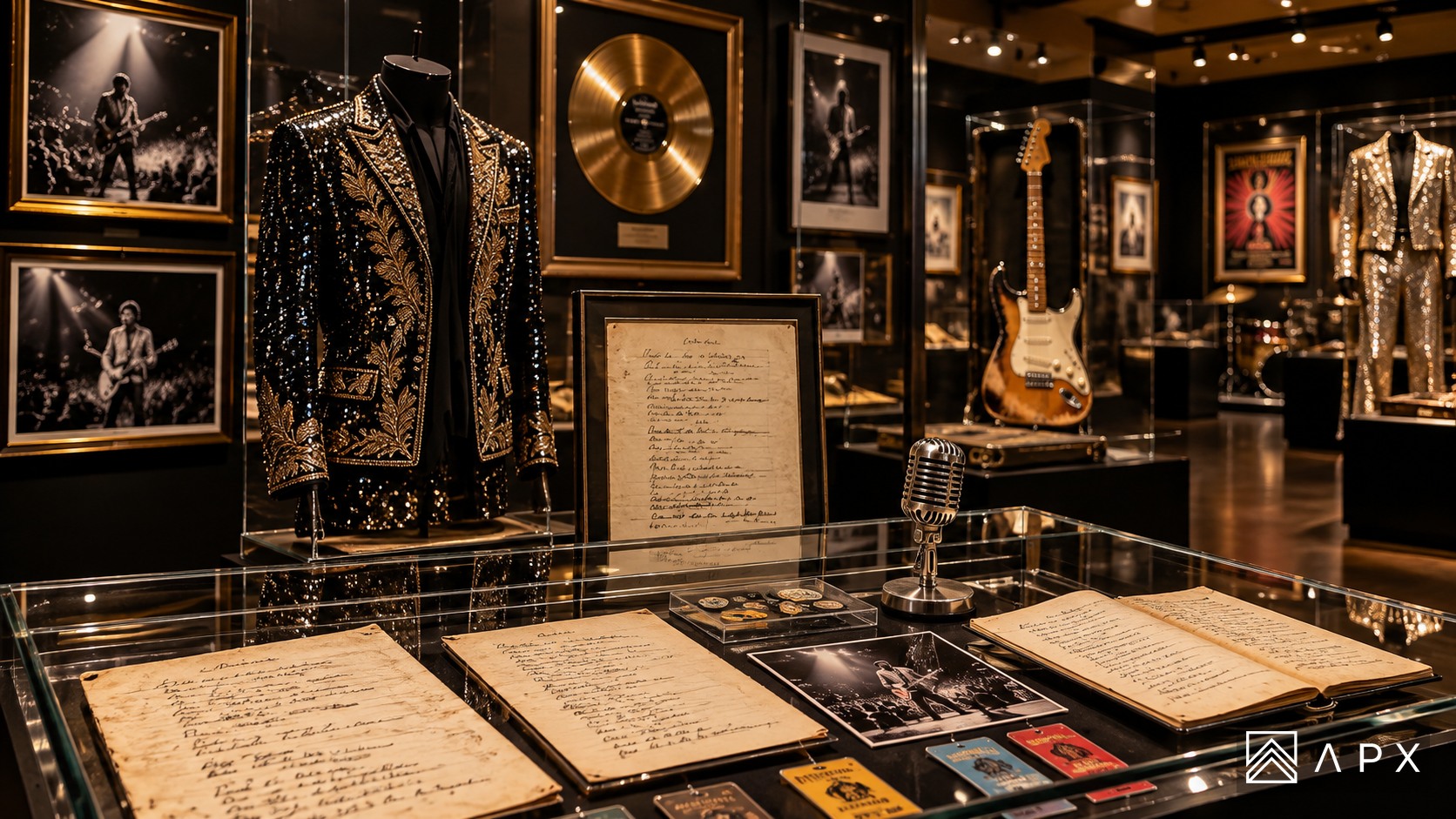
Handwritten lyrics, stagewear and personal artefacts can carry extraordinary cultural value. APX examines provenance, scarcity and collector risk beyond guitars.
Executive Summary
The high-end music memorabilia market extends well beyond instruments. Handwritten lyrics, stage-worn clothing, awards, manuscripts, set lists, recording documents and personal artefacts can all attract serious collector demand when they connect directly to important artists and defining cultural moments. Recent institutional auction activity shows how deeply provenance and narrative influence value: Christie’s 2026 Jim Irsay Collection set new records for both handwritten lyrics and a guitar.
Key Takeaways
- Connection to a defining moment matters. A generic autograph and a manuscript created during a landmark recording session occupy very different markets.
- Provenance should be cumulative. Letters, photographs, catalogue history and chain of ownership strengthen each other.
- Stagewear is visual culture. Recognisability in photographs or performances can create a powerful collector premium.
- Lyrics can combine literary and music history. Drafts, corrections and alternate wording can reveal the creative process.
- Condition is not always about perfection. Wear may be evidence of use, but restoration and conservation need documentation.
Why the Category Has Expanded
Major auction houses now treat popular culture as a serious specialist field. Christie’s describes its category as encompassing music memorabilia, film props, screen-worn wardrobe, instruments and personal artefacts from important figures in entertainment history.
This institutionalisation gives collectors better cataloguing, condition reporting and market visibility than the category historically enjoyed.
Handwritten Lyrics: The Creative Object
Lyrics can be uniquely compelling because they document the creative act itself. Draft wording, crossings-out, studio paper and revisions can all add context. Christie’s 2026 Jim Irsay sale set a record for lyrics when Bob Dylan’s handwritten manuscript for The Times They Are a-Changin’ sold for $2.515 million.
That result should not be applied broadly to every manuscript, but it demonstrates the market’s willingness to value culturally important working documents as significant artefacts.
Stagewear and Visual Recognition
Stage clothing can command attention when it is instantly associated with an artist, era or performance. Photographic matching strengthens the case. Christie’s archives include documented Freddie Mercury stagewear accompanied by photographs, fan-club provenance and prior sale history.
For collectors, the distinction between 'owned by' and 'worn during a documented performance' can be substantial.
Awards, Passes and Personal Objects
Gold records, tour passes, notebooks, correspondence and studio ephemera can build a collection around a broader cultural narrative. These categories are often more accessible than trophy instruments or lyrics, but provenance standards should be no lower.
Authentication and Provenance
A serious file may include estate documentation, letters from band or management personnel, photographs, previous auction catalogues, serial numbers, studio records and expert opinions. The best provenance explains not only who owned the item but how it left the artist’s possession and passed to the current owner.
Conservation and Display
Paper, textiles, plastics and magnetic media all age differently. Ink can fade, fabrics can deteriorate under UV exposure and adhesives or poor framing materials can damage documents. Museum-quality framing and controlled humidity may matter more to long-term value than decorative presentation.
Building a Coherent Collection
Family offices should decide whether the objective is artist concentration, genre, era, cultural importance or cross-category collecting. A coherent collection can often tell a stronger story than a random group of celebrity objects and may be easier to catalogue, insure and eventually sell.
APX Perspective
Music memorabilia is most compelling when it provides direct access to cultural creation rather than merely celebrity association. The strongest objects are simultaneously documentary, visual and scarce. For serious collectors, provenance discipline remains the bridge between emotional appeal and defensible long-term value.
Frequently Asked Questions
What types of music memorabilia are most collectible?
Important handwritten lyrics, stage-worn clothing, instruments, awards and personal artefacts can attract strong demand when provenance and cultural significance are clear.
Is a certificate of authenticity enough?
Not always. Strong provenance usually combines several forms of evidence and a documented chain of ownership.
Does wear reduce value?
Not necessarily. Authentic use can be part of the object’s history, although damage, restoration and conservation should be carefully documented.
Related APX Intelligence
Sources & Further Reading
APX Intelligence is provided for general informational purposes only and does not constitute investment, valuation, insurance or conservation advice. Collectibles are illiquid and values may fall as well as rise.