
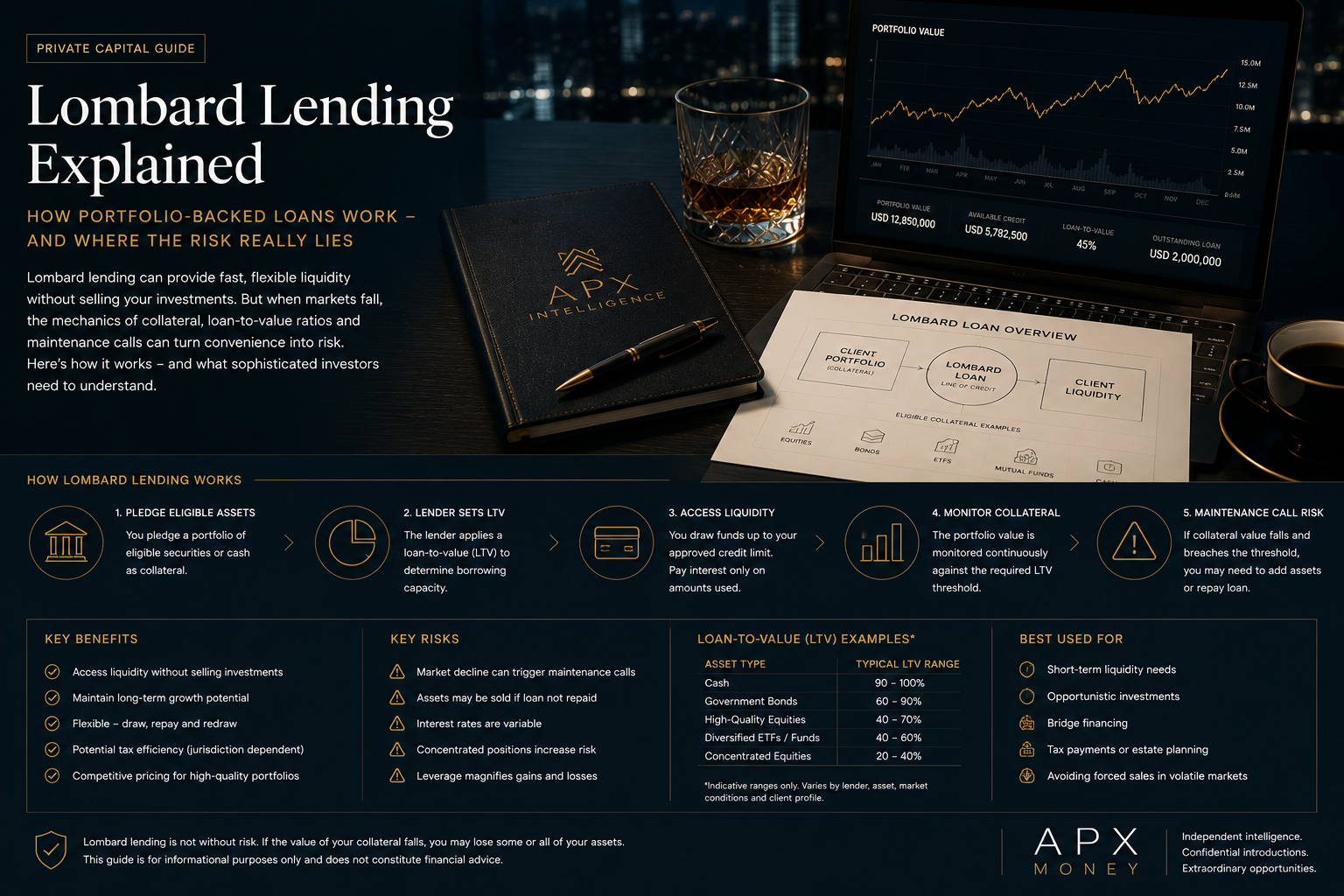
Lombard Lending Explained: How Portfolio-Backed Loans Work — and Where the Risk Really Lies
An institutional private banking guide on credit advance rates, collateral haircuts, maintenance call mechanics, interest rate risk, and stress-testing portfolio leverage.
Executive Summary
Lombard lending is one of the most established liquidity tools in private banking. At its simplest, an investor pledges eligible financial assets — such as cash, bonds, equities or investment funds — as collateral and borrows against them without selling the underlying portfolio. For UHNW families, the attraction is obvious. Capital can be accessed quickly while long-term investment positions remain intact. But the apparent simplicity hides an important asymmetry. When markets rise, the structure can feel efficient and almost invisible. When markets fall, collateral values decline, borrowing capacity can shrink and the lender may require additional assets or partial repayment at precisely the moment the investor least wants to sell. That makes Lombard lending less a question of access to capital and more a question of balance-sheet resilience. The central issue is not: "How much will the bank lend?" It is: "How much can the family safely borrow without allowing a market correction to dictate its next move?"
Key Takeaways
- Liquidity Without Disposal: Lombard lending enables investors to borrow against eligible financial assets without liquidating underlying positions.
- Divergent Advance Rates: Lenders assign distinct lending values (haircuts) to different asset classes based on volatility, liquidity, and credit quality.
- Market Value vs. Borrowing Capacity: Total portfolio market value does not equal collateral capacity; loan-to-value (LTV) limits dictate borrowing power.
- Maintenance Call Trigger Mechanics: Falling asset values can rapidly trigger mandatory margin calls, forcing asset sales at market bottoms if unaddressed.
- Concentration Penalty: Single-stock equity holdings receive significantly reduced lending values compared to globally diversified multi-asset portfolios.
- Floating Rate Exposure: Unhedged benchmark interest rate hikes can materially inflate annual debt service costs independently of portfolio performance.
- Double-Leverage Danger: Deploying borrowed portfolio liquidity into high-risk secondary assets compounds balance-sheet losses exponentially during market drawdowns.
- Pre-Emptive Structuring: Establishing undrawn credit lines during calm market conditions creates "prepared liquidity" without operational pressure.
1. What Is Lombard Lending?
A Lombard loan is generally a credit facility secured against financial assets held with a bank or investment institution.
Eligible collateral may include:
- cash;
- government bonds;
- investment-grade fixed income;
- listed equities;
- exchange-traded funds;
- mutual funds;
- and other approved securities.
The lender does not value all assets equally. Instead, each holding is assigned a lending value based on factors such as:
- volatility;
- liquidity;
- credit quality;
- concentration;
- market depth;
- currency;
- and the lender's own risk policy.
The combined lending value determines how much credit the borrower can access.
2. Why UHNW Families Use It
The primary advantage is simple: liquidity without disposal.
A family may want to retain a long-term investment portfolio while requiring cash for:
- property acquisition;
- business investment;
- tax obligations;
- a capital call;
- philanthropy;
- bridge financing;
- aircraft or yacht acquisition;
- or an opportunistic investment.
Selling securities to create that liquidity can disrupt asset allocation and potentially trigger tax consequences depending on jurisdiction and circumstances.
Borrowing creates a different outcome: the portfolio remains invested while a separate liquidity facility is established against it.
3. Loan-to-Value Is the Core Mechanism
Suppose an investor holds £20 million of assets. That does not mean the bank will lend £20 million.
The lender determines a loan-to-value ratio, or LTV, based on the quality of the collateral.
| Asset Category | Sample Market Value | Illustrative Advance Rate Range | Borrowing Capacity Output |
|---|---|---|---|
| Cash Equivalents | £2,000,000 | 90% – 95% | £1,800,000 – £1,900,000 |
| Government Bonds | £5,000,000 | 80% – 90% | £4,000,000 – £4,500,000 |
| Diversified Global Equities | £8,000,000 | 50% – 60% | £4,000,000 – £4,800,000 |
| Concentrated Single Stock | £5,000,000 | 20% – 30% (or Nil) | £1,000,000 – £1,500,000 |
The exact lending ratios vary materially between lenders and market conditions. The key point is that market value and borrowing value are not the same thing.
4. Why Concentration Matters
Consider two families. Both have portfolios worth £25 million.
Family A owns a globally diversified portfolio across equities and fixed income. Family B has £20 million invested in shares of one technology company.
| Portfolio Profile | Total Market Value | Typical LTV Cap | Collateral Vulnerability to 40% Drop |
|---|---|---|---|
| Family A: Diversified Multi-Asset | £25,000,000 | 60% (£15,000,000) | Moderate drawdown cushion across uncorrelated assets. |
| Family B: Single Tech Holding | £25,000,000 | 25% (£6,250,000) | Severe drawdown risk; triggers immediate margin call. |
A lender typically views a concentrated position as more vulnerable to sudden decline. If that single company falls 40%, the collateral base deteriorates rapidly.
This is particularly relevant for founders and entrepreneurs whose wealth remains tied to one listed company. Their balance sheets can appear enormous while still being relatively fragile from a collateral perspective.
5. The Maintenance Call
This is the risk every borrower needs to understand before drawing the facility.
$$\text{Initial: } \frac{\text{Loan } £8\text{m}}{\text{Portfolio } £20\text{m}} = 40\% \text{ LTV} \quad \xrightarrow{\text{Market Drop}} \quad \text{New: } \frac{\text{Loan } £8\text{m}}{\text{Portfolio } £13\text{m}} = 61.5\% \text{ LTV}$$
If the loan now exceeds the permitted contractual threshold, the borrower receives a maintenance call. The lender may require:
- additional eligible securities;
- cash;
- partial repayment;
- or other acceptable collateral.
If the borrower cannot satisfy the requirement, securities may be sold.
This creates the central danger of portfolio-backed leverage: the lender can force liquidity at the worst possible time. The investor may believe the market will recover, but the bank does not necessarily need to wait.
6. Borrowing Capacity Is Not Risk Capacity
This is one of the most important distinctions for family offices.
A private bank might be prepared to lend a significant amount against a portfolio. That does not mean the family should borrow that amount.
$$\text{Maximum Bank Limit } (\text{Lender's Risk}) \quad \neq \quad \text{Safe Operational Drawdown } (\text{Borrower's Risk})$$
Sophisticated borrowers often maintain substantial headroom between actual borrowing and theoretical maximum capacity. That buffer can become invaluable during volatile markets.
7. The Interest-Rate Risk
Lombard facilities are often priced relative to a benchmark rate (SOFR, SONIA, EURIBOR) plus a lender margin. That means borrowing costs may move.
$$\text{Base Cost (4.0%): } £10\text{m} \times 4\% = £400,000/\text{yr} \quad \longrightarrow \quad \text{Stress Cost (6.5%): } £10\text{m} \times 6.5\% = £650,000/\text{yr}$$
Nothing about the asset or loan size has changed—only the price of money. This matters because a structure that appears economically compelling when rates are low can become considerably less attractive later.
8. When Lombard Lending Works Well
The structure can be highly effective where:
- Temporary Liquidity: Bridging a property purchase ahead of an expected business distribution.
- Diversified Portfolio: Collateral is isolated from single-stock idiosyncratic crashes.
- Conservative Leverage: Borrowing remains below 35–40% LTV, providing huge market drawdown buffers.
- Strong Cash Flow: Independent income comfortably covers floating interest payments.
- Defined Exit Strategy: A clear, time-bound event exists to pay down the facility.
9. When It Becomes Dangerous
Problems tend to emerge when several risks combine simultaneously:
- concentrated collateral;
- high initial LTV (>60%);
- volatile markets;
- floating interest rates;
- weak independent cash flow;
- and borrowed funds invested into another risky asset.
Now the family has leverage on both sides of the balance sheet. If collateral falls while the new investment also performs badly, losses can compound rapidly. What began as a liquidity tool becomes a forced-deleveraging mechanism.
10. The Double-Leverage Problem
Suppose a family owns a £30 million investment portfolio, borrows £10 million against it, and uses that £10 million to acquire a private investment.
$$\text{Total Market Exposure} = \text{Public Collateral } (£30\text{m}) + \text{Leveraged Private Investment } (£10\text{m}) = £40\text{m}$$
If public markets fall, the collateral deteriorates. If the private investment simultaneously requires more capital, liquidity pressure increases. This is why borrowing to fund consumption and borrowing to fund risk assets should be analysed differently. Purpose matters.
11. Lombard Lending vs Selling Investments
There is no universal answer. Comparing both routes requires examining specific balance-sheet variables:
| Decision Variable | Selling Portfolio Holdings | Executing Lombard Credit Line |
|---|---|---|
| Tax Consequence | Triggers immediate Capital Gains Tax (CGT). | Deferral of taxable event; debt isn't income. |
| Upside Exposure | Forfeits all future market growth & yields. | Retains full ownership benefits & dividend flow. |
| Downside Risk | Losses capped at sale price; zero leverage risk. | Subject to maintenance margin calls & forced sales. |
| Cost Profile | One-off transaction execution commissions. | Ongoing interest expense + floating benchmark risk. |
The mistake is assuming one route is inherently more sophisticated than the other. Sometimes the sophisticated decision is simply to sell.
12. Lombard Lending for Property Purchases
One common use is purchasing property without immediately liquidating investments.
Imagine a family wishes to acquire a £7 million residence. Rather than selling a securities portfolio, they use a Lombard facility to complete the transaction quickly. This allows them to move faster, avoid portfolio disruption, retain market exposure, and refinance later.
But the family now has property exposure and portfolio-backed debt. The balance sheet should therefore be viewed as a whole. The property does not eliminate the risk attached to the Lombard facility.
13. Using Lombard Lending for Business Opportunities
Entrepreneurs may also use portfolio-backed liquidity to fund acquisitions, support operating companies, bridge corporate transactions, or provide shareholder capital.
This avoids selling personal investments, but it introduces another layer of correlation. If the operating business and financial markets both deteriorate during an economic downturn, the family may simultaneously face weaker business cash flow, falling collateral, and higher financing stress.
Again, the structure must be resilient to conditions being worse than expected.
14. Currency Matters
International families often hold assets and liabilities in different currencies. Imagine a portfolio primarily denominated in US dollars supporting a loan in euros. Currency movements can influence collateral and debt relationships.
A family office should examine asset currency, loan currency, income currency, future spending currency, and hedging requirements. A loan that looks conservatively structured in one currency can change when exchange rates move.
15. Tax Is Not the Same as Liquidity Planning
Lombard lending is sometimes marketed around tax efficiency. That requires caution.
Borrowing creates liquidity without an immediate sale of appreciated securities, but taxation depends upon the borrower's jurisdiction, residence, asset structure, and use of proceeds.
$$\text{Correct Strategy Sequence: } \text{Commercial Rationale} \longrightarrow \text{Risk Architecture} \longrightarrow \text{Liquidity} \longrightarrow \text{Tax Advice}$$
16. The Wrong Time to Arrange a Facility
Families often begin thinking about liquidity after a problem appears. That is usually too late.
During stressed markets, collateral values are already falling, lenders become conservative, borrowing margins widen, and urgency weakens negotiating power.
A stronger approach is to establish prepared liquidity—putting credit lines in place while markets are calm, even if left undrawn.
17. Why Family Offices Should Run Stress Tests
Before drawing a substantial facility, the investment committee should model adverse scenarios:
- Scenario 1: Portfolio falls 15%.
- Scenario 2: Portfolio falls 30%.
- Scenario 3: Portfolio falls 30% AND benchmark interest rates rise 200 bps.
- Scenario 4: Collateral falls while a major private equity capital call arrives.
- Scenario 5: Collateral falls while an un-refinanced real estate purchase completes.
The question is simple: Does the family still have enough liquidity to remain in control? If not, borrowing is too aggressive.
18. The Psychological Risk of Easy Credit
There is another danger that receives less attention. Lombard borrowing can feel almost frictionless: the investor retains the portfolio, no asset is visibly sold, and liquidity appears immediately.
This can make debt feel less real than conventional borrowing. But economic leverage absolutely exists. Ease of access makes governance discipline even more critical.
19. Lender Diversification
Large family offices may consider spreading credit relationships across multiple private banks.
Maintaining several banking relationships delivers pricing competition, alternative collateral policies, geographic diversification, and different currency capabilities.
However, multiple facilities introduce administrative complexity and can lead to overlapping security arrangements. The family office needs a consolidated view of total leverage.
20. What Happens if the Lender Changes Its Rules?
Borrowers focus heavily on current loan terms, but lenders operate within evolving risk frameworks. In stressed conditions, a lender may adjust lending values, alter eligible collateral lists, increase margins, or reduce credit appetite.
Facility documentation determines what the bank is legally entitled to do. Borrowers must evaluate how much unilateral discretion the lender retains tomorrow.
21. Lombard Lending vs Securities-Backed Lines
Terminology varies between regions. Lombard loan is standard in European and Asian private banking, while securities-backed line of credit (SBLOC) is common in North America.
The core principle is identical: marketable securities support debt. However, specific legal covenants, usage restrictions, and regulatory margin frameworks differ by jurisdiction.
22. The APX Liquidity Test
Before drawing against a portfolio, family offices should answer eleven diagnostic questions:
- 1. Why is the liquidity required?
- 2. For how long will the facility remain open?
- 3. What percentage of total net worth is being pledged?
- 4. How diversified is the collateral basket?
- 5. What is the initial LTV?
- 6. What occurs after a 20%, 30%, or 40% market decline?
- 7. Can unencumbered secondary collateral be injected immediately?
- 8. Is the borrowing rate fixed, capped, or floating?
- 9. What is the exact pre-planned repayment exit?
- 10. Could the lender liquidate securities without prior borrower consent during default?
- 11. What aggregate leverage exists across the entire balance sheet?
And critically: Would the family still choose this structure if markets fell 25% the day after the loan was drawn?
23. Frequently Asked Questions
Q: What is a Lombard loan?
A: A Lombard loan is generally a credit facility secured against eligible financial assets such as cash, bonds, equities and investment funds.
Q: Do you keep ownership of the investments?
A: Typically, the borrower retains economic ownership subject to the security arrangements agreed with the lender. The assets remain pledged as collateral.
Q: What happens if the investment portfolio falls?
A: If collateral values fall sufficiently, the lender may require additional collateral or partial repayment. Under the facility documentation, securities may potentially be sold if the borrower cannot restore the required collateral level.
Q: How much can you borrow?
A: Borrowing capacity depends on the type, quality, diversification, liquidity and volatility of the assets, together with lender policy and market conditions.
Q: Are concentrated shareholdings accepted?
A: Potentially, but concentrated positions may receive more conservative lending values because they expose the lender to greater volatility and liquidity risk.
Q: Is Lombard lending cheaper than selling investments?
A: That is not the right comparison in isolation. Borrowing has interest, collateral and leverage risks. Selling can create tax, market-timing and opportunity-cost consequences. The answer depends on the specific balance sheet.
Q: Is a Lombard loan suitable for long-term borrowing?
A: It can be used over different periods depending on structure, but variable collateral and interest-rate risk mean families should consider carefully whether it is appropriate for long-duration financing.
24. Institutional Glossary
- Lombard Facility
- A revolving or term credit facility granted by a private bank and secured by liquid or marketable financial instruments deposited with the lender.
- Lending Value (Advance Rate)
- The discounted percentage of an asset's market value that a bank recognizes as eligible security for borrowing.
- Maintenance Margin Call Threshold
- The strict contractual LTV limit at which a lender legally requires cash injection, secondary collateral, or involuntary asset liquidation.
- Double-Leverage Compounding
- The compounded balance-sheet risk incurred when debt raised from an existing liquid portfolio is used to acquire secondary illiquid or volatile risk assets.
- Prepared Liquidity Buffer
- Pre-negotiated, undrawn credit lines established during calm market conditions to maintain strategic flexibility during unexpected market volatility.
25. Institutional Verification & Advisory Standards
For private bankers, family office treasurers, and wealth fiduciaries, portfolio-backed credit facilities should be evaluated against established banking standards:
| Governance Dimension | Regulatory Body / Standard | Primary Verification & Compliance Protocol |
|---|---|---|
| Prudential Credit Limits | Basel III Framework / PRA | Counterparty Credit Risk (CCR) & Collateral Haircut Haircut Standards. |
| Securities Margin Rules | FINRA Rule 4210 / FCA Credit Code | Maintenance Margin Directives & Automatic Liquidation Safeguards. |
| Portfolio Risk Analytics | ISDA / Private Banking Association | Value-at-Risk (VaR) & Stress-Testing Protocols for Lombard Collateral. |
26. The APX Perspective
Lombard lending is powerful because it converts an investment portfolio into something more than a collection of assets: it becomes an engine of structured liquidity.
For sophisticated families, that flexibility can be enormously valuable. But liquidity is only valuable when it preserves choice.
A highly leveraged portfolio-backed facility can have precisely the opposite effect—allowing market volatility and lender collateral rules to dictate when assets must be sold.
The objective should therefore not be to maximize borrowing. It should be to maximize financial optionality while preserving control.
Good leverage creates flexibility. Bad leverage removes it. That distinction should sit at the center of every family-office discussion about portfolio-backed borrowing.


