
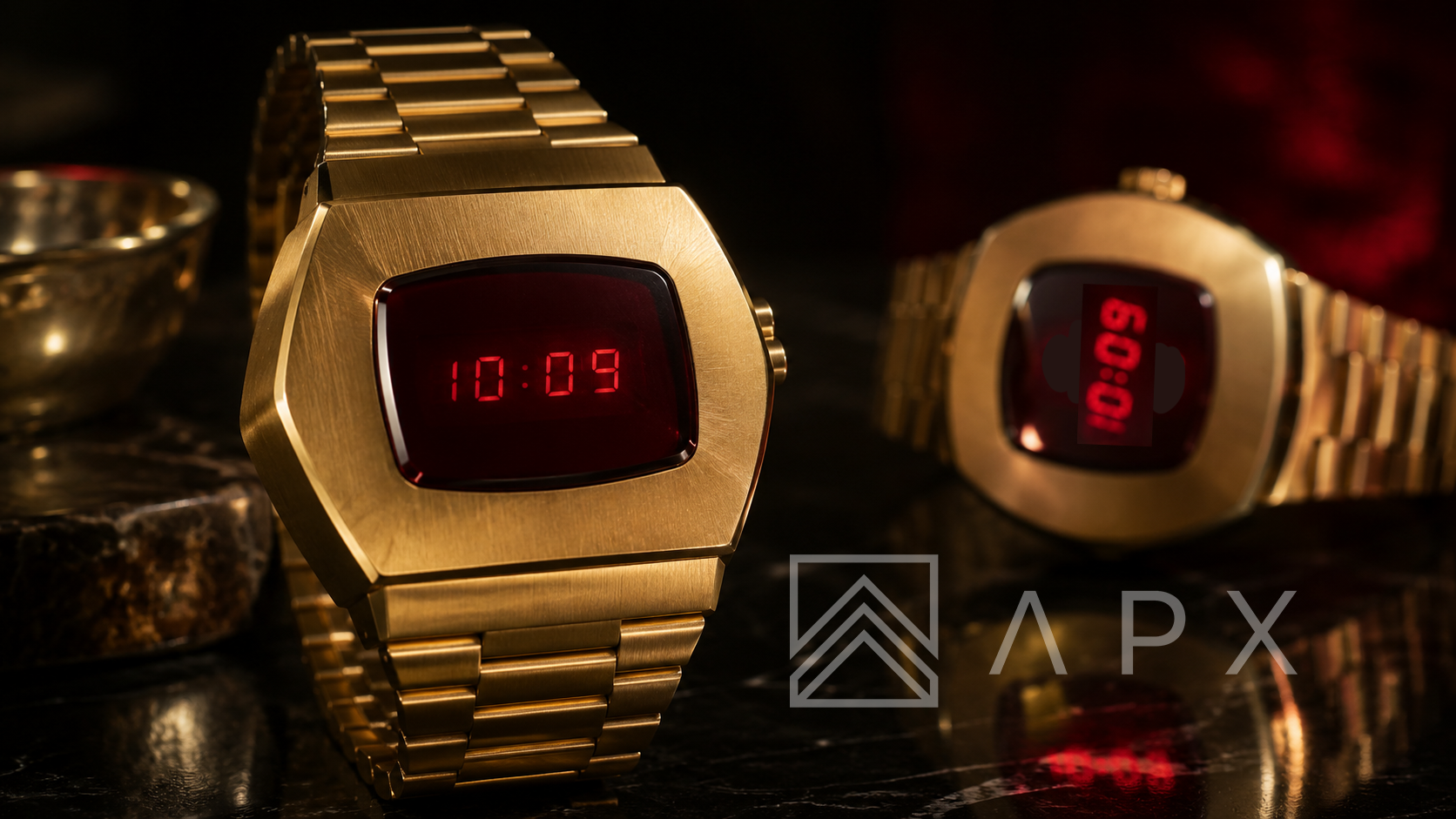
Hamilton Pulsar P1 & P2: Collector's Guide to the First Luxury Digital Watch
Before digital watches became inexpensive and ubiquitous, the Pulsar arrived as an expensive piece of futuristic jewellery. More than fifty years later, the challenge for collectors is separating historically important survivors from altered, incomplete or poorly restored examples.
Executive Summary
When the Hamilton Pulsar reached the market in 1972, it did not look like the beginning of cheap digital watchmaking. It looked like the future.
The original gold Pulsar used a completely electronic LED display, had no conventional hands and showed the time only when its button was pressed. Hamilton priced the first model at $2,100, an extraordinary figure for the period, and produced only 400 examples.
Its significance today lies in the intersection of horology, industrial design, early consumer electronics and 1970s culture.
Yet buying one is very different from buying a conventional vintage mechanical watch. Electronic modules can fail, components can have been replaced, bracelets altered and cases refinished. A visually attractive watch can therefore be historically compromised, while an imperfect but original survivor may be far more important.
The collector is not simply buying a digital watch. They are buying an artefact from the moment electronics began to redefine the wristwatch itself.
Key Takeaways
- The P1 is historically significant: Hamilton identifies the 1972 Pulsar as the world's first electronic digital watch with an LED display.
- The original production was extremely limited: Hamilton states that only 400 examples of the first gold watch were produced.
- It was a luxury object: the original $2,100 price placed the Pulsar closer to high-end jewellery and luxury watches than to the inexpensive digital watches that followed.
- Originality matters as much as functionality: a working replacement module may make a watch usable, but can materially change its historical interest.
- The P2 brought the concept into popular culture: Hamilton confirms that Roger Moore wore a Pulsar in the 1973 James Bond film Live and Let Die.
- Condition assessment is specialist work: case integrity, bracelet length, LED display quality, module generation, battery damage and previous repair work all affect collectability.
1. Why the Pulsar Was Revolutionary
Modern collectors are accustomed to electronic watches being inexpensive, accurate and disposable.
The Pulsar emerged in a completely different context.
Mechanical watches had dominated personal timekeeping for generations. The traditional wristwatch consisted of a movement, hands and a dial, with technological progress usually taking place inside an established visual format.
Pulsar removed that format almost entirely.
Its dark synthetic ruby display appeared blank until the wearer pressed a button. Red light-emitting diodes then illuminated the hour and minute. Holding the control longer could display the seconds.
Hamilton marketed the concept as a time computer.
That description captured what made the watch extraordinary. It did not merely improve a mechanical watch. It proposed an entirely different relationship between electronics and timekeeping.
The Smithsonian's National Museum of American History now holds an early Pulsar in its collection, placing the watch within the broader story of American electronics and technological miniaturisation rather than treating it purely as a fashion accessory.
2. The P1: The Original 1972 Watch
The first production Pulsar occupies a special position because the object itself contradicted almost everything digital watches later became.
It was rare, expensive and made in gold.
Hamilton states that only 400 examples of the original 1972 watch were produced and that the launch price was $2,100 — more than the price of a car at the time.
This matters to collectors because it reframes the P1.
It was not designed as a low-cost alternative to traditional watchmaking. It was positioned as an elite technological object: part watch, part jewellery and part demonstration of what solid-state electronics could become.
The heavy precious-metal case and integrated bracelet reinforced that message. Technology alone was not enough. The futuristic display had to inhabit something that still communicated luxury.
This tension is central to the watch's appeal today.
The P1 combined an electronic future with the traditional luxury language of gold.
3. The Electronics Inside the P1
The electronic architecture is one of the reasons early Pulsars require a different kind of due diligence from mechanical watches of the same period.
The Smithsonian preserves an early Pulsar LED module from the first 400 watches. Its records describe a module containing 25 integrated circuits.
Power consumption was a significant limitation.
Unlike a contemporary LCD display, the red LEDs could not remain illuminated continuously without rapidly exhausting the batteries. The display therefore remained dark until the wearer deliberately activated it.
That interaction became one of the Pulsar's defining characteristics.
Yet the same electronics that made the watch extraordinary also create the principal challenge for today's collector.
More than five decades later, an original electronic module is not simply another movement that any conventional watchmaker can rebuild using traditional methods. Corrosion, battery leakage, ageing electronic components and historic repairs can all affect reliability.
Specialist knowledge therefore matters.
4. The P2 and the Move Into Popular Culture
The P1 proved that an electronic digital wristwatch could exist as a commercial luxury product.
The P2 developed the idea into a more recognisable production watch and became one of the visual icons associated with the early digital era.
Its smooth case, dark display and glowing red numerals distilled the futuristic language of the period into a design that could be recognised instantly.
Importantly for collectors, the P2 exists in a broader variety of configurations than the first-generation P1.
That means a buyer must look beyond the simple word Pulsar.
Case material, bracelet, module, reference, serial details and production variant can make a substantial difference to desirability and value.
Precious-metal examples occupy a different collector category from more common steel watches, but rarity alone should not override condition and originality.
5. The James Bond Connection
The Pulsar's cultural reach extended far beyond horology.
Hamilton confirms that Roger Moore wore a Pulsar while playing James Bond in the 1973 film Live and Let Die.
The significance of the appearance is easy to overlook today.
Bond had long embodied technological sophistication. Putting an LED watch on his wrist presented digital timekeeping not as a cheap novelty, but as something advanced enough for the world's most famous fictional secret agent.
It also captured a precise cultural moment.
Space exploration, integrated circuits, electronic calculators and futuristic industrial design had changed expectations about what personal technology might look like.
The Pulsar belonged naturally within that world.
6. Why Collectors Are Reassessing Early Digital Watches
Traditional watch collecting has historically been dominated by mechanical complexity.
Chronographs, perpetual calendars, minute repeaters and finely finished movements have occupied the highest tiers of the market because they demonstrate mechanical craftsmanship.
The Pulsar asks collectors to value something different.
Its importance lies in technological first-mover status, industrial design and cultural influence rather than hand-finished mechanical complication.
This makes the watch increasingly relevant to collectors whose interests extend beyond traditional horology into:
- industrial design;
- early consumer electronics;
- space-age aesthetics;
- 20th-century technology;
- film and cultural history;
- rare precious-metal watches;
- museum-grade design objects.
Hamilton's decision to revive the design through the modern PSR also demonstrates that the silhouette remains an important part of the company's historical identity.
7. Originality vs Restoration
This is perhaps the most important issue in buying an early Pulsar.
A conventional vintage mechanical watch can often be serviced while retaining most of its original architecture. Electronic watches present a more complicated question because historical repairs may involve replacing an entire module or significant electronic components.
That creates two legitimate but different collector objectives.
The wearable collector
This buyer prioritises a functioning display and may accept sympathetic electronic restoration or replacement components if the work is documented and the watch remains visually correct.
The historical collector
This buyer may place significantly more weight on the originality of the early module, even if the watch is less convenient to use or requires specialist preservation.
Neither approach is inherently wrong.
The problem arises when a restored or replacement-module watch is marketed as completely original.
For a rare P1, provenance of the electronics can be as important as provenance of the case.
8. What to Inspect Before Buying
Early Pulsars should be assessed as complete systems rather than simply as cases containing digital movements.
| Area | What to Check | Why It Matters |
|---|---|---|
| Reference & Model | Confirm whether the watch is genuinely a P1, P2 or another Pulsar reference. | Different generations have very different rarity and collector significance. |
| Case Material | Verify hallmarks and whether the watch is solid gold, gold filled, plated or steel. | Descriptions of vintage Pulsars are frequently imprecise. |
| Electronic Module | Determine the module type, originality, repair history and whether components have been substituted. | The electronics are central to historical authenticity. |
| LED Display | Check brightness, consistency and correct operation. | Weak or irregular segments may indicate ageing or electronic issues. |
| Battery Compartments | Inspect for corrosion or historic battery leakage. | Battery damage can affect both electronics and case condition. |
| Crystal | Inspect scratches, chips, replacement parts and fit. | The dark display surface is one of the defining visual elements of the watch. |
| Bracelet | Check originality, full length, clasp, hallmarks and previous repairs. | Integrated precious-metal bracelets can materially affect completeness and value. |
| Case Finishing | Look for excessive polishing and softened geometry. | Heavy refinishing can permanently remove original form and surface detail. |
| Provenance | Review invoices, service records, photographs and previous ownership history. | Documentation can help establish both authenticity and restoration history. |
9. How to Think About Value
Vintage Pulsar values should not be reduced to a simple model-by-model price list.
The market is too thin and individual watches vary too dramatically in originality, condition and electronic state.
A better framework is to evaluate six separate value drivers:
- Model rarity — particularly whether the watch belongs to the original P1 production.
- Case material — solid precious metal, gold-filled or steel.
- Originality — including module, crystal, bracelet and case components.
- Functionality — whether the LED display and controls operate correctly.
- Condition — especially case geometry, crystal and evidence of corrosion.
- Provenance — documentation, service history and credible ownership history.
Auction evidence also demonstrates why broad price ranges can be misleading.
Sotheby's, for example, offered an 18k yellow-gold Pulsar calculator watch from circa 1980 with an estimate of $8,000–$12,000 in 2024. That is not a P1, but it illustrates the degree to which rare precious-metal Pulsars can occupy a very different market from ordinary vintage digital watches.
The correct comparison therefore needs to be reference-specific.
10. Is a Vintage Pulsar an Investment?
The Pulsar has several characteristics that collectors often associate with desirable long-term objects:
- genuine technological significance;
- low production of the first-generation model;
- strong design identity;
- precious-metal examples;
- museum recognition;
- film and cultural provenance;
- an established manufacturer that continues to celebrate the design.
None of these guarantees financial appreciation.
Early electronic watches also carry risks that conventional vintage watches may not:
- limited specialist repair capability;
- scarcity of original electronic components;
- difficulty establishing module originality;
- battery-related damage;
- thin transaction volumes;
- large valuation differences between superficially similar watches.
For that reason, the strongest acquisition thesis is not:
“This digital watch will appreciate.”
It is:
“This is a scarce surviving object from one of the most important transitions in modern timekeeping.”
11. Frequently Asked Questions
Why is the Hamilton Pulsar P1 historically important?
The 1972 Hamilton Pulsar P1 was the first commercially released electronic digital wristwatch with an LED display. It replaced hands and a conventional dial with illuminated numerals and represented a major change in both watch design and consumer electronics.
How many original Hamilton Pulsar P1 watches were produced?
Hamilton states that only 400 examples of the original 1972 gold Pulsar were produced, making the first-generation model significantly scarcer than the later P2 and subsequent Pulsar references.
What should collectors check before buying a vintage Pulsar?
Collectors should verify the precise reference, case material, serial numbers, bracelet, module generation, display condition, battery compartments, case integrity, service history and provenance. A functioning display is useful, but originality and the quality of previous repairs can be equally important.
Is the Pulsar P2 the James Bond watch?
Hamilton confirms that Roger Moore wore a Pulsar in the 1973 James Bond film Live and Let Die. The association helped establish the later Pulsar design as one of the defining digital watches of the early 1970s.
Are vintage Hamilton Pulsar watches good investments?
Rare and original Pulsars can be highly collectible, but they should not be treated as guaranteed investments. Value depends on model, originality, precious-metal content, condition, module functionality, provenance and collector demand. Restoration and electronic replacement parts can materially affect desirability.
Verification & Source Notes
Historical details and individual watch specifications should be checked against primary manufacturer records, museum archives and specialist auction catalogues before acquisition.
- Hamilton: historical Pulsar material confirming the 1972 launch, LED technology, production of 400 original examples and $2,100 launch price.
- Smithsonian National Museum of American History: early Hamilton Pulsar wristwatch and first-generation LED module records.
- Hamilton Cinema Archive: confirmation of Roger Moore wearing the Pulsar in Live and Let Die.
- Sotheby's: auction evidence for later precious-metal Pulsar watches, useful as a market reference rather than a direct valuation of the P1.
12. The APX Perspective
The mistake is to judge the Pulsar by what digital watches eventually became.
By the end of the twentieth century, digital timekeeping was inexpensive and commonplace. In 1972, it was neither.
The original Pulsar combined an experimental electronic architecture, precious metal, industrial design and extreme pricing into a product that attempted to make the future wearable.
That is why the strongest examples deserve to be evaluated differently from ordinary vintage quartz watches.
The Pulsar matters not because digital watches became cheap, but because this was the moment digital timekeeping was still extraordinary.
APX Connect
Looking to acquire a rare vintage Pulsar, early electronic watch or historically significant timepiece?
APX members can use APX Connect to request confidential introductions to relevant watch specialists, dealers, collectors, auction professionals and other network participants. All requests are reviewed by APX before an introduction is made.
For dealers, collectors and horology specialists: APX also works with contributors seeking to present significant watches, specialist expertise and market intelligence to a curated private network.
Continue Your Journey
I Want to Acquire
Explore watches and specialist assets presented through the APX network.
Browse ListingsI Want to Sell
Present a significant watch or collection to a curated network of qualified members.
List an AssetI Need an Introduction
Request a confidential connection to an appropriate watch specialist or network participant.
APX ConnectI Want to Contribute
Share horology intelligence, market expertise or significant opportunities with APX members.
Become a Contributor


