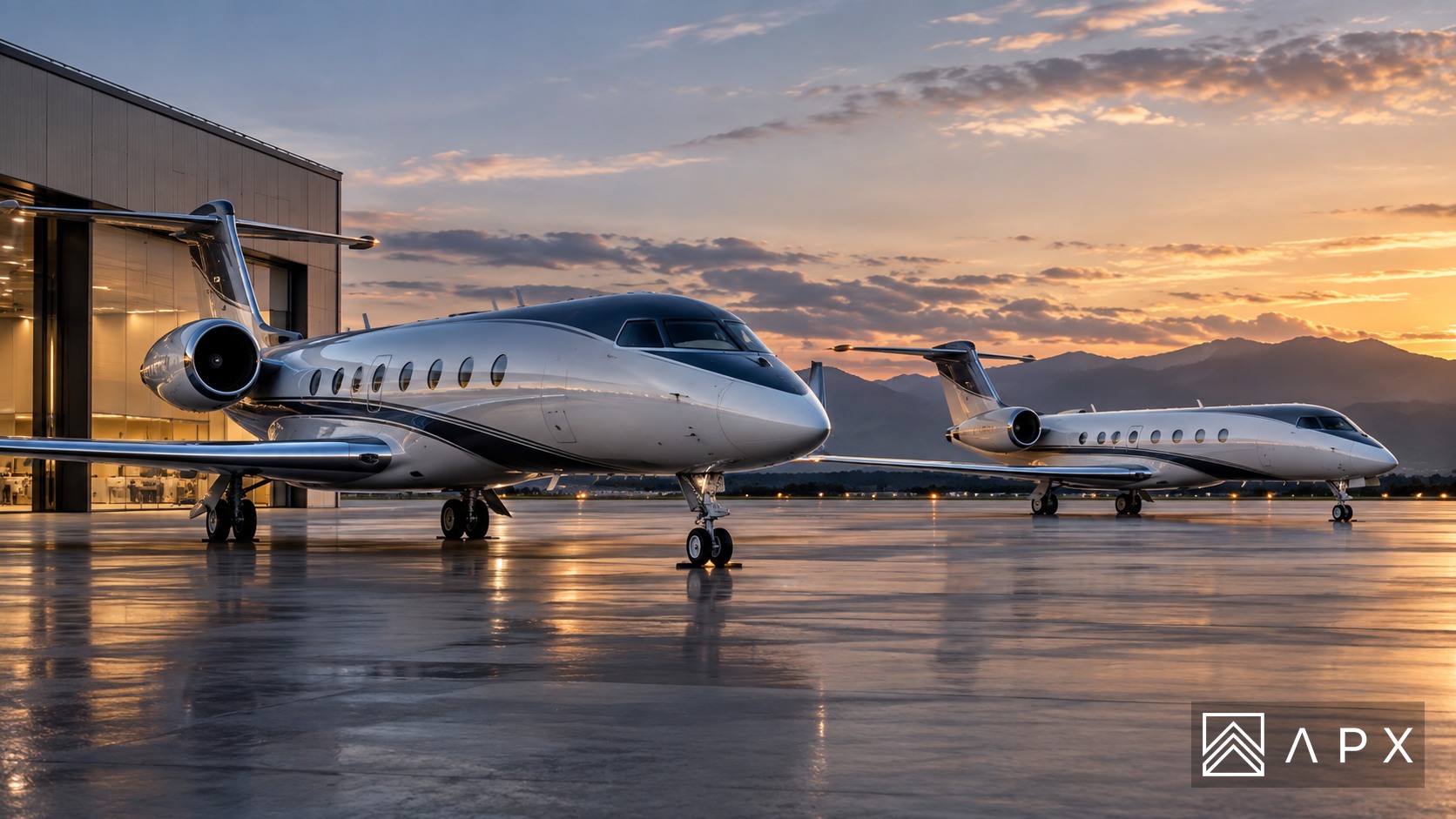
APX compares the Gulfstream G700 and G650ER across range, cabin space, speed, flight-deck generation and the ownership questions that matter to UHNW principals.
Executive Summary
The Gulfstream G700 and G650ER are separated by only 250 nautical miles of published maximum range, yet they represent materially different ownership propositions. The G650ER remains one of the defining ultra-long-range business aircraft of its generation. The G700 adds a significantly longer cabin, a fifth potential living area, newer flight-deck architecture and a higher maximum operating Mach number.
For an owner, the decision is therefore less about whether both aircraft can perform intercontinental missions — they can — and more about how much value is placed on cabin zoning, newest-generation systems, acquisition timing and the economics of stepping into a newer platform.
Key Takeaways
- Range is close: Gulfstream publishes 7,750 nm for the G700 and 7,500 nm for the G650ER under their respective stated conditions.
- The cabin difference is substantial: the G700 cabin is 56 ft 11 in excluding baggage, versus 46 ft 10 in for the G650ER.
- Both cruise fast: long-range cruise is Mach 0.85 and high-speed cruise Mach 0.90; the G700 has a higher published maximum operating Mach of 0.935 versus 0.925 for the G650ER.
- The G700 is about space and generation: up to five living areas, 20 panoramic windows and the Symmetry Flight Deck materially change the onboard proposition.
- The G650ER remains mission-capable: for principals who do not need the additional cabin length, a well-specified G650ER can still cover the core ultra-long-range mission set.
G700 vs G650ER: The Numbers That Matter
According to Gulfstream’s published specifications, the G700 offers a maximum range of 7,750 nautical miles, maximum operating Mach 0.935 and up to five living areas. The G650ER product specification lists a maximum range of 7,500 nautical miles and maximum operating Mach 0.925.
The greater distinction is cabin length. Both aircraft share a published finished cabin height of 6 ft 3 in and width of 8 ft 2 in, but the G700’s cabin length excluding baggage is 56 ft 11 in, compared with 46 ft 10 in for the G650ER. That additional length is what enables the G700’s broader zoning possibilities.
1. Mission Capability: More Similar Than the Headlines Suggest
For many owners, either aircraft can connect the city pairs that define an ultra-long-range flight department. Published maximum range is only one part of mission planning; real-world performance depends on payload, winds, routing, temperature, reserves, airport elevation and cruise profile.
That means the practical question is not simply whether the G700 can fly 250 nm farther under published conditions. It is whether the owner’s recurring missions sit close enough to the edge of G650ER capability for that additional margin to matter.
A family routinely moving between North America, Europe, the Gulf and major Asian hubs may find that both aircraft satisfy most missions. A principal regularly flying the longest non-stop sectors with demanding payload requirements may place more value on every increment of range and high-speed capability.
2. Cabin: This Is Where the G700 Creates Clear Separation
The G700 is Gulfstream’s largest cabin and can be configured with up to five living areas. Gulfstream also states seating for up to 19 passengers and sleeping accommodation for up to 13 depending on configuration.
The extra cabin length changes how the aircraft can be used on a 12- or 14-hour sector. Instead of treating the cabin as a sequence of seats, owners can separate work, dining, lounge, private-suite and crew functions more decisively.
The G650ER remains a large, highly capable cabin, but the physical difference becomes obvious when the operating requirement includes simultaneous privacy: one group working, another resting, a principal using a private suite and crew maintaining service without repeatedly crossing occupied zones.
3. Speed and Time Saving
Gulfstream publishes Mach 0.90 as the high-speed cruise figure for both aircraft. The G700’s maximum operating Mach number is higher at 0.935, compared with 0.925 for the G650ER.
For owners, however, headline maximum speed should not be confused with the economics of every mission. Flight departments manage speed against fuel, weather, maintenance planning and arrival constraints. The value of high-speed cruise is greatest when it compresses genuinely useful travel time rather than simply producing a faster technical sector.
4. Flight Deck and Aircraft Generation
The G700 uses Gulfstream’s Symmetry Flight Deck with active control sidesticks and extensive touchscreen integration. Gulfstream also highlights its Combined Vision System and Predictive Landing Performance System.
The G650ER belongs to the previous generation of Gulfstream large-cabin design and uses a different avionics architecture. That does not make it obsolete; it does mean an owner comparing the two should consider training commonality, flight-department fleet mix, support strategy and the value placed on newest-generation cockpit systems.
5. Cabin Environment and Passenger Experience
The G700 has 20 Gulfstream panoramic oval windows and a published cabin altitude of 2,840 ft at 41,000 ft. Gulfstream also promotes 100% fresh air replenishment every two to three minutes.
These features matter because an ultra-long-range aircraft is not merely transport. It is a working and living environment occupied for much of a day. Noise, light, sleeping arrangements, connectivity, galley capability and separation between principal, guests and crew can be as important to the ownership decision as another few hundred nautical miles of theoretical range.
6. Acquisition Economics: Newest Platform vs Mature Asset
Purchase price alone is not a sufficient comparison, particularly when one aircraft is a current-generation platform and the other is now primarily encountered in the pre-owned market. Specification, age, maintenance status, engine programmes, connectivity upgrades, cabin refurbishment and availability can materially alter the effective acquisition cost of a G650ER.
The G700 proposition is different: the buyer is paying for the newest cabin architecture, systems generation and factory-new configuration. The family office should therefore model total capital employed rather than simply comparing advertised aircraft prices.
APX has previously examined the wider question of fractional versus outright corporate aviation ownership. The same discipline applies here: define annual utilisation, mission profile and capital objectives before allowing the aircraft choice to drive the ownership structure.
7. The G650ER Case
The G650ER remains compelling when the mission does not require the G700’s extra cabin zone. Its 7,500 nm published range, Mach 0.90 high-speed cruise and established operating history still place it firmly within the ultra-long-range category.
For an owner prioritising availability, known fleet characteristics and the possibility of acquiring a carefully selected pre-owned aircraft, the G650ER can be an efficient way to access most of the mission capability without automatically stepping into the newest flagship.
8. The G700 Case
The G700 is the stronger proposition when cabin architecture itself is strategic. A family regularly undertaking very long sectors with multiple passengers, simultaneous business activity, dedicated rest requirements or a desire for the newest Gulfstream flight-deck environment will use the additional space rather than merely admire it.
The question is therefore whether the fifth living area and longer cabin solve a real operating problem. If they do, the G700 is not simply a newer G650ER; it is a materially different onboard environment.
Questions a Family Office Should Ask Before Choosing
- What are the ten most frequent city pairs flown today?
- How many passengers are normally carried on the longest missions?
- How often must passengers work, dine and sleep simultaneously?
- Does the principal require a genuinely private suite?
- What is the expected annual utilisation?
- Will the aircraft join an existing Gulfstream fleet or stand alone?
- How important are factory-new configuration and newest-generation avionics?
- What capital is tied up during acquisition and delivery?
- Which aircraft can realistically be placed into service on the required timetable?
- What does the five- and ten-year exit plan look like?
APX Perspective
The G700 is the more capable cabin platform, but the G650ER remains close enough in core range and cruise performance that the decision should not be reduced to specification-sheet hierarchy.
For some principals, the G700’s additional ten feet of cabin length and fifth living area transform long-range travel. For others, those benefits may not justify the additional capital when a high-quality G650ER already covers the required missions. The correct answer comes from utilisation, cabin behaviour and balance-sheet strategy — not from choosing the newest aircraft by default.
Related APX Intelligence
Sources & Further Reading
Aircraft performance varies with payload, weather, routing, runway conditions, configuration and operating procedures. APX Intelligence is provided for general informational purposes only and does not constitute aviation, financial, legal, tax or investment advice. Aircraft acquisition decisions should be supported by appropriately qualified aviation, technical, legal and financial advisers.