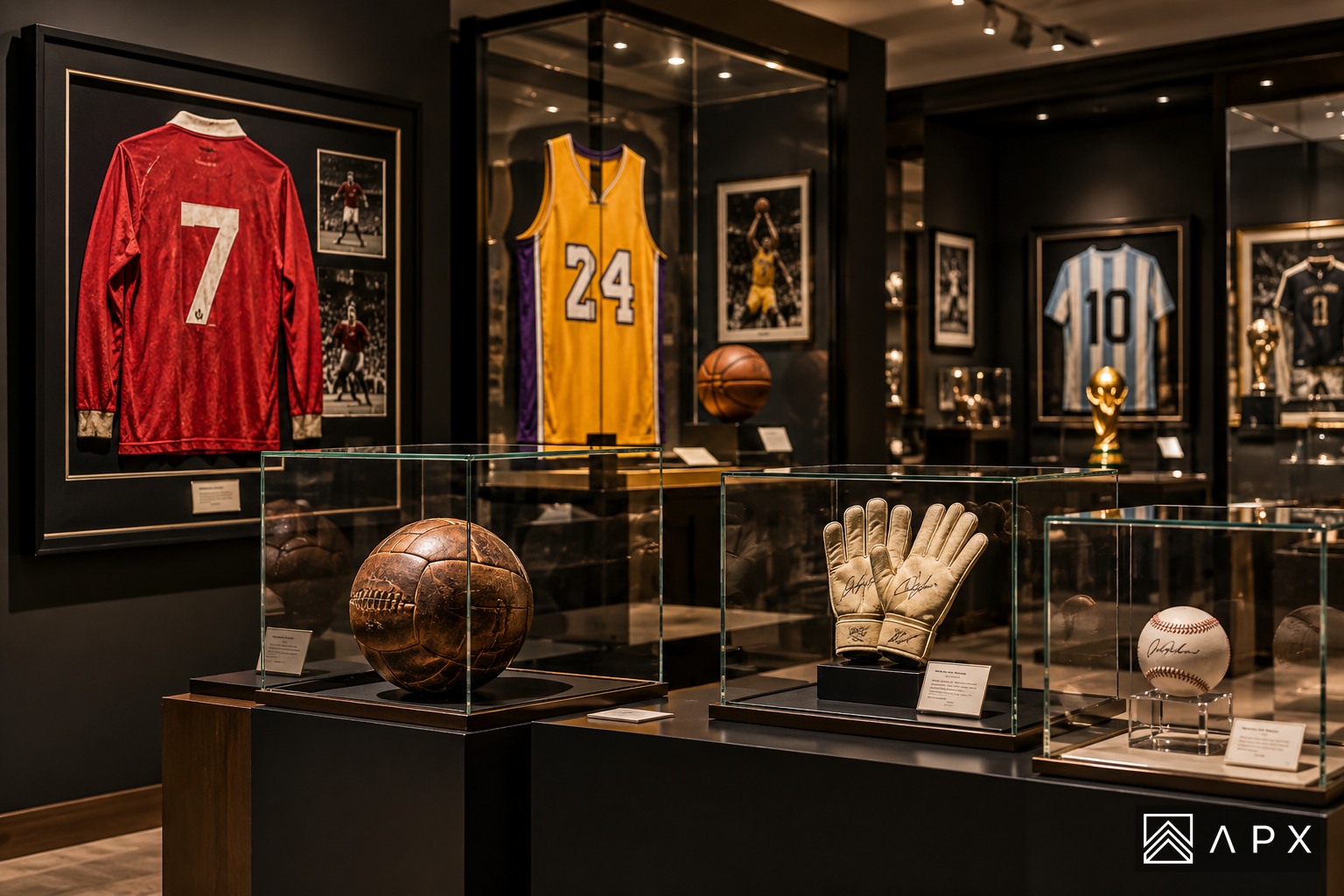
Game-worn jerseys and historic sporting objects are becoming a serious collecting category. APX examines provenance, photomatching and value.
Executive Summary
Sports memorabilia has moved from a fan-led collecting niche into a professionalised global market in which game use, photomatching and provenance increasingly determine value. Sotheby’s describes sports memorabilia as one of its fastest-growing categories and now runs official game-worn programmes with major rights holders. For collectors, the central question is not whether an object is signed or rare, but whether its connection to a particular athlete, match and moment can be demonstrated.
Key Takeaways
- Game-worn beats generic. The closer an item is to a defining moment, the stronger the collector case can become.
- Photomatching is transforming authentication. Unique marks, stitching and wear can connect an item to specific footage or photographs.
- Records are concentrated at the top. Trophy assets can command extraordinary prices while ordinary signed merchandise remains far more liquid but less scarce.
- Authentication is not a one-time task. Provenance files should be maintained and updated as collections move between owners.
- Insurance and storage matter. Textiles, leather and paper require conservation standards very different from conventional financial assets.
Why the Category Is Growing Up
Sotheby’s has described sports memorabilia as one of its fastest-growing collecting categories. Its partnerships with leagues such as the NBA have also changed how important objects reach the market: jerseys can move from court to auction with a documented chain of custody and, in many cases, photomatching.
That matters because the historic weakness of sports memorabilia was uncertainty. Autographs could be forged, match use exaggerated and provenance reduced to an anecdote. Institutional auction processes do not eliminate risk, but they create more structured evidence.
Provenance, Photomatching and the Moment Premium
Collectors increasingly pay for an identifiable moment rather than simply an athlete’s name. A jersey worn in a championship game, record-breaking performance or culturally important match can carry a premium over another shirt from the same season.
Photomatching compares wear patterns, repairs, loose threads, stains, numbering and other physical details against high-resolution images or broadcast footage. It is particularly powerful for game-worn apparel because the item itself develops a unique visual fingerprint.
The Record Market — and What It Does Not Mean
Sotheby’s lists several category records, including Michael Jordan’s 'Last Dance' NBA Finals jersey at $10.1 million and Diego Maradona’s 'Hand of God' shirt at $9.3 million. These prices demonstrate the depth of demand for trophy assets, but they should not be extrapolated across the market.
The majority of sports memorabilia is far more modestly priced. The gap between a historically significant, fully documented item and routine signed merchandise is enormous. Investors who ignore that distinction risk paying a trophy premium for an ordinary object.
Authentication: Build a File, Not a Certificate
A serious collection should retain auction invoices, letters of authenticity, photo-match reports, provenance statements, prior ownership records, conservation notes and high-resolution images. If an item has been graded or encapsulated, the grader’s details should be retained as part of the file rather than treated as a substitute for it.
Market Selection: Athlete, Sport and Geography
Global stars can attract cross-border demand, but collecting markets remain culturally specific. Football, basketball, baseball, Formula One, boxing and tennis have different buyer bases, auction calendars and conventions. A family office building a collection should decide whether it is pursuing historical importance, personal passion, investment potential or some combination of the three.
Storage, Insurance and Lending
Textiles should be protected from UV light, humidity and poor framing materials. Leather, paper and footwear have different conservation needs. Insurance schedules should be updated after major auction results or new authentication evidence, and loan agreements for exhibitions should define responsibility during transport and display.
APX Perspective
The most investable sports objects increasingly resemble other museum-grade collectibles: they have a clear story, independent evidence, recognisable cultural importance and constrained supply. The market is becoming easier to analyse precisely because provenance is becoming more structured. Passion still matters — but at the upper end, documentation is what turns passion into a defensible collecting thesis.
Frequently Asked Questions
What is photomatching in sports memorabilia?
Photomatching compares unique physical details on an item with photographs or video to establish that it was used in a particular game or event.
What types of sports memorabilia tend to attract the strongest demand?
Items connected to defining moments, iconic athletes, championships and record-breaking performances generally attract the deepest collector interest.
Is sports memorabilia liquid?
Liquidity varies widely. Trophy assets can attract global bidders, while less significant items may take time to sell and can be highly price-sensitive.
Related APX Intelligence
Sources & Further Reading
APX Intelligence is provided for general informational purposes only and does not constitute investment, valuation, tax, legal or insurance advice. Collectible values are volatile and past auction records do not predict future returns.