
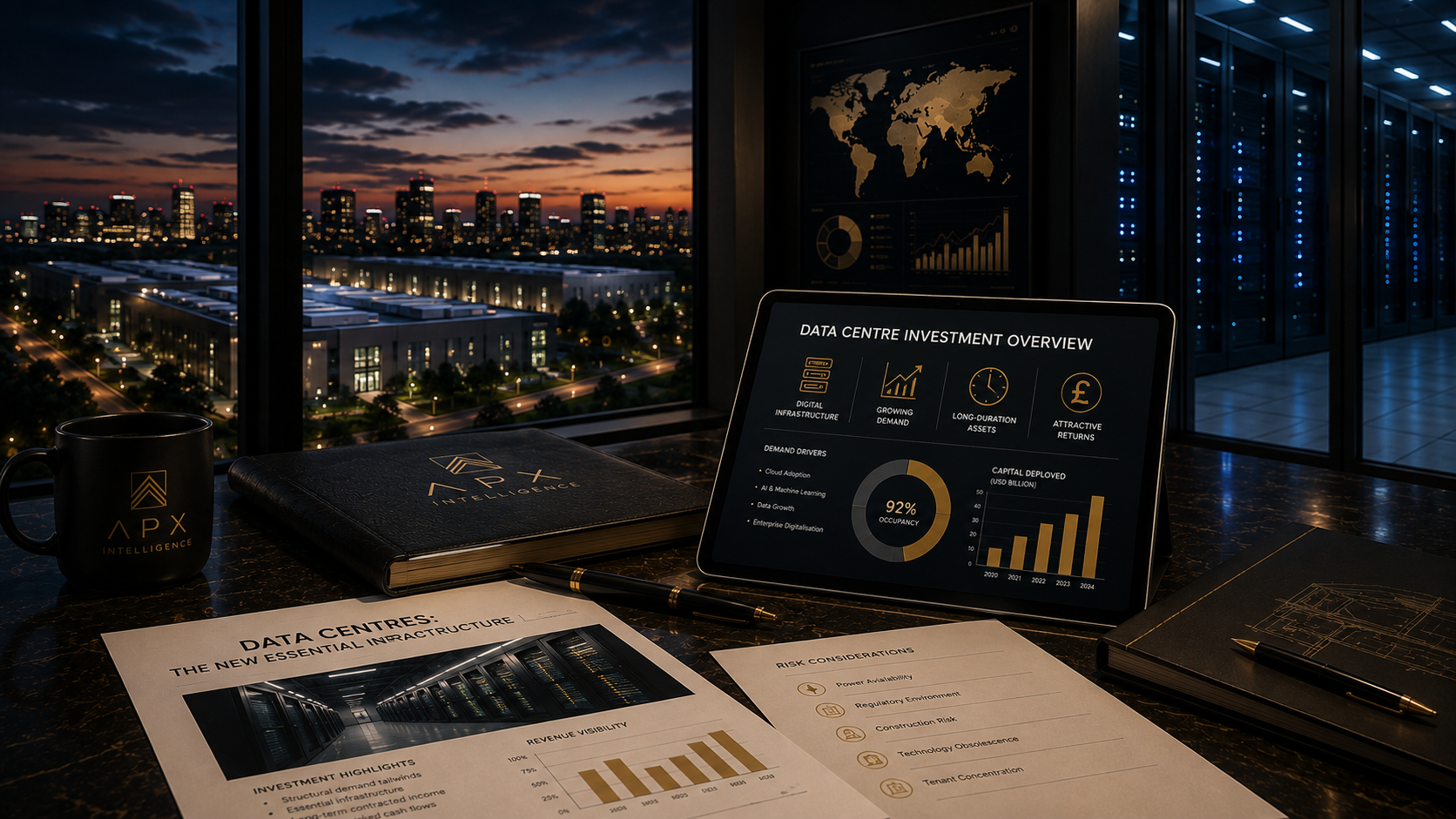
Data Centres: Why Family Offices Are Investing in the Infrastructure Behind Artificial Intelligence
An institutional analysis of AI computing demand, power grid constraints, hyperscale tenant concentration, liquid cooling retrofits, and digital asset allocation strategies.
Executive Summary
The artificial-intelligence investment story is usually told through semiconductors, software companies and technology platforms. But every AI model ultimately depends upon something considerably more physical. Land. Buildings. Electricity. Cooling. Fibre. Servers. Data centres are the industrial infrastructure of the digital economy, and the extraordinary growth of artificial intelligence has brought an asset class once regarded as a specialist corner of commercial property firmly into the sights of institutional and private capital. For family offices, the proposition can appear compelling: own the infrastructure required by cloud providers, technology businesses and increasingly compute-intensive AI systems rather than attempting to identify which individual technology company will ultimately dominate. Yet the apparent simplicity is deceptive. A data centre is not merely a warehouse containing computers. Power availability, grid connectivity, fibre access, cooling technology, planning, water, tenant concentration, construction costs and technological obsolescence can determine whether an apparently attractive development becomes a strategic digital asset—or an expensive building incapable of supporting the next generation of computing. The investment question is therefore evolving from: "Where can we build another data centre?" to: "Where can we secure the power, connectivity and infrastructure required for computing demand that does not yet exist?"
Key Takeaways
- Physical Foundations: Data centres provide the essential physical infrastructure supporting cloud computing, artificial intelligence, enterprise software, and digital services.
- Density Acceleration: AI model training and inference workloads are driving demand for unprecedented, high-density megawatt computing capacity.
- Power Over Property: Secured electrical grid capacity and utility availability have become vastly more critical than the physical building itself.
- Hybrid Asset Mechanics: Data-centre investing uniquely blends the characteristics of real estate, digital infrastructure, regulated utilities, and technology operating companies.
- Evolving Location Paradigms: Geographic proximity remains critical for low-latency workloads, but AI training clusters are redefining prime site parameters around power access.
- Hyperscale Exposure: Hyperscale tenants (e.g., AWS, Microsoft, Google) deliver long-term contracted cash flows while introducing significant customer concentration risks.
- Obsolescence Management: Rapid technological evolution in GPU density and liquid cooling can render older, air-cooled facilities competitive liabilities.
- Structuring Routes: Investors must distinguish clearly between yield-generating operating facilities, high-upside development sites, powered land banking, and supporting utility infrastructure.
1. The Physical Reality Behind the Digital Economy
The language surrounding technology encourages us to imagine something almost weightless.
The cloud sounds intangible. Artificial intelligence sounds entirely digital. Neither is.
Every search query, streaming service, payment transaction, corporate database and AI calculation ultimately requires physical computing infrastructure somewhere in the world. That infrastructure consumes:
- land;
- electricity;
- cooling;
- telecommunications connectivity;
- equipment;
- engineering;
- and capital.
The more digital the global economy becomes, the greater its dependence upon physical infrastructure. That contradiction sits at the centre of the data-centre investment thesis: Digital growth creates real-asset demand.
2. Why Artificial Intelligence Changes the Equation
Traditional data centres were already benefiting from cloud adoption, streaming, e-commerce, digital payments and corporate digitisation.
Generative AI has added another potentially powerful source of demand. Training sophisticated models can require enormous computational resources. Operating those models at scale can require substantial resources too.
That creates demand for specialised computing infrastructure capable of supporting increasingly power-dense hardware. The consequence is important for investors.
The data centre designed for yesterday's enterprise computing requirements may not automatically be suitable for tomorrow's AI workloads. Facilities may require:
- greater electrical capacity;
- different cooling systems;
- redesigned rack configurations;
- stronger power redundancy;
- advanced networking;
- and substantial capital expenditure.
AI therefore creates opportunity while simultaneously increasing obsolescence risk.
3. Power May Be the Real Scarce Asset
For decades, property investors asked: Where is the best land? Data-centre investors increasingly ask: Where is the power?
A site can possess excellent transport links, fibre connectivity and planning permission yet remain commercially compromised if sufficient electricity cannot be secured. In some established data-centre markets, access to grid capacity can involve substantial delays.
This changes the investment hierarchy. A relatively unremarkable parcel of land with secured power can potentially be more strategically valuable than a seemingly superior site without it.
$$\text{Land} + \text{Power} + \text{Fibre} + \text{Planning} + \text{Cooling} = \text{Compute Capacity}$$
Remove one component and the investment proposition can deteriorate rapidly.
4. Data Centres Are Not Conventional Property
It is tempting to analyse a data centre as specialised commercial real estate. That only captures part of the picture.
The building itself may represent a relatively modest component of the overall economic ecosystem. Value can depend upon:
- electrical infrastructure;
- generators and backup systems;
- cooling;
- security;
- network connectivity;
- operating reliability;
- customer contracts;
- technical capability;
- and future expansion capacity.
This makes data centres unusual hybrid assets. They contain elements of:
$$\text{Real Estate} + \text{Infrastructure} + \text{Utilities} + \text{Technology} + \text{Operating Businesses}$$
Investors experienced in conventional warehouses or office buildings should therefore be cautious about assuming that the same underwriting framework automatically applies.
5. The Hyperscaler Effect
A significant part of global computing demand comes from large cloud and technology platforms often described as hyperscalers.
Securing a substantial long-term contract with a major technology tenant can appear extremely attractive. It can provide:
- revenue visibility;
- creditworthy counterparties;
- substantial capacity commitments;
- and potentially long-duration contractual income.
But this creates an investment paradox. The better the tenant, the easier it can be to overlook concentration risk.
If one customer represents the majority of facility revenue, the asset's economics may be highly dependent upon that relationship. Investors should therefore examine not only tenant creditworthiness but also:
- contract duration;
- renewal provisions;
- pricing;
- capital obligations;
- expansion rights;
- termination clauses;
- and what happens if the facility must eventually be re-let.
A building designed around one customer's requirements may not be equally attractive to the next.
6. Location Still Matters—But Differently
For conventional property, prime locations often mean city centres, affluent neighbourhoods or major logistics corridors. Data centres operate under different geography.
| Site Selection Vector | Strategic & Operational Impact |
|---|---|
| Power Availability | Substation capacity, transmission proximity, and grid interconnection timelines. |
| Connectivity & Latency | Proximity to major subsea cable landings, dark fibre paths, and Internet Exchange Points (IXPs). |
| Regulatory Environment | Planning policies, municipal zoning, carbon emissions limits, and water consumption caps. |
| Climate & Natural Hazards | Ambient temperatures impacting free-cooling efficiency; isolation from seismic or flood risks. |
Different facilities also serve different purposes. Some workloads benefit enormously from proximity to major population centres. Others can potentially operate much farther away.
AI training may therefore alter traditional assumptions about where large computing facilities need to be located. The next important data-centre cluster may not necessarily resemble the last.
7. Cooling: An Investment Issue, Not an Engineering Footnote
Computers produce heat. High-density computing produces a great deal of it. Removing that heat reliably and efficiently is fundamental to data-centre economics.
Traditional air-cooling systems may become less suitable for some increasingly dense computing configurations, encouraging greater interest in advanced and liquid-cooling technologies.
For investors, cooling affects:
- capital expenditure;
- operating expenditure;
- water requirements;
- energy efficiency;
- equipment density;
- and future compatibility.
A facility unable to support evolving cooling requirements may face significant retrofit costs. The investment committee therefore needs to understand something that would once have sounded absurd in a property meeting: How exactly are we going to cool the computers?
8. The Water Question
Data centres are increasingly scrutinised not only for electricity consumption but also for water usage. Cooling technologies differ substantially, and local environmental conditions matter.
In water-stressed regions, competition for resources can become politically and socially sensitive. This creates potential exposure to:
- planning restrictions;
- environmental regulation;
- community opposition;
- operating constraints;
- and reputational risk.
Sustainability therefore cannot simply be treated as an ESG paragraph at the back of an investment memorandum. Resource availability can directly affect asset economics.
9. Build It—or Buy It?
Family offices considering digital infrastructure can enter the market through several distinct execution routes:
| Investment Route | Risk-Return Profile & Operational Mechanics |
|---|---|
| Operating Assets | Existing facilities with contracted cash flow. Lower development risk; pricing reflects maturity. |
| Development Projects | Greenfield/brownfield sites. High value creation; exposure to planning, grid connection, and leasing risk. |
| Powered Land Banking | Securing land with guaranteed high-MW grid allocations prior to vertical build out. Strategic optionality. |
| Joint Ventures & Funds | Partnering with operating platforms or specialist funds. Combines family capital with technical expertise. |
For many family offices without direct operating expertise, co-investments or specialist fund vehicles may be vastly more appropriate than attempting to become a data-centre developer overnight.
10. The AI Gold Rush Problem
Whenever an investment theme becomes fashionable, capital follows. That creates risk.
Investors can begin paying prices based not on existing economics but on expectations of extraordinary future demand. AI infrastructure is particularly susceptible to this.
There is a fundamental difference between: AI will require enormous computing capacity and: Therefore every data centre is an attractive investment at any price.
The first proposition may be correct while the second is entirely wrong. Capital discipline remains essential. An investor must still ask:
- What are we paying?
- What income exists today?
- What future development expenditure is required?
- What assumptions underpin occupancy?
- What happens if supply increases?
- What happens if computing becomes more efficient?
- What return compensates us for those risks?
Structural growth does not abolish valuation.
11. Technology Can Reduce Demand Too
There is another side to the AI infrastructure thesis. Technology becomes more efficient.
Semiconductors improve. Software optimisation improves. Models may require less computational resource to achieve comparable results. Workloads may migrate between different hardware architectures.
This does not necessarily mean computing demand will fall; efficiency can itself stimulate additional usage. But investors should resist linear forecasts.
Today's relationship between AI capability and electricity consumption may not remain constant indefinitely. A thirty-year real asset exposed to a five-year technology cycle requires careful thinking.
12. Grid Infrastructure: The Investment Behind the Investment
One of the more interesting consequences of data-centre growth may occur outside the data centres themselves.
If computing requires substantially more electricity, capital must also flow into the infrastructure supplying it. That can create opportunities across:
- electricity generation;
- transmission;
- grid reinforcement;
- substations;
- battery storage;
- backup generation;
- renewable energy;
- power-management technology;
- and potentially nuclear generation.
For some family offices, the more compelling AI infrastructure investment may therefore sit one layer beneath the data centre. Instead of trying to predict who owns the winning computing facility, investors can examine the infrastructure every facility requires.
13. Fibre: The Digital Road Network
Electricity allows computers to operate. Connectivity allows them to communicate.
Fibre networks therefore form another essential component of digital infrastructure. The analogy with transportation is useful:
$$\text{Data Centres} = \text{Destinations} \quad \Big| \quad \text{Fibre Networks} = \text{Connecting Highways}$$
High-quality connectivity can materially influence location attractiveness, redundancy and performance. As computing infrastructure becomes more geographically distributed, the network linking facilities becomes increasingly important.
This expands the investable ecosystem beyond the data-centre building itself.
14. Sovereign Computing and Data Residency
Governments are becoming increasingly conscious of where critical data and computing infrastructure are located.
Data sovereignty, cybersecurity and national resilience can influence both regulation and investment. Countries may seek greater domestic computing capability rather than relying entirely upon infrastructure located overseas.
For investors, this can create opportunities—but also additional complexity. Data-centre investment increasingly intersects with:
- national security;
- foreign investment rules;
- privacy regulation;
- critical infrastructure policy;
- and geopolitical considerations.
The cloud may be global. Regulation remains national.
15. Why Family Offices Are Looking at the Sector
Data centres can possess several characteristics attractive to long-duration private capital:
- Structural Demand: Global digitisation continues to increase computing requirements.
- Real-Asset Exposure: Investors own or finance physical infrastructure rather than relying solely upon technology-company valuations.
- Contracted Revenue: Certain assets may benefit from longer-term customer agreements.
- Inflation Characteristics: Some structures may incorporate pricing mechanisms capable of providing partial inflation protection.
- Development Potential: Securing scarce power and strategically located land can create substantial value.
- Diversification: Digital infrastructure can provide exposure to technology growth through a very different economic mechanism than owning public technology equities.
But none of those characteristics makes the sector low-risk. The operational and technical complexity is considerable.
16. The Risks Investment Committees Should Examine
Evaluating digital infrastructure transactions requires a comprehensive risk assessment framework:
| Risk Factor | Underwriting Impact & Threat Mechanics |
|---|---|
| Power Availability | Delays in utility grid delivery can stall operations and destroy project IRRs. |
| Development Risk | Planning hurdles, supply chain bottlenecks for transformers, and construction inflation. |
| Tenant Concentration | Over-reliance on a single hyperscaler creating severe re-leasing vulnerability at expiry. |
| Technological Obsolescence | Inability to support dense GPU clusters or liquid cooling retrofits. |
| Environmental & Water | Municipal water caps, carbon intensity taxes, and local community opposition. |
| Valuation Compression | Paying aggressive entry multiples based on speculative AI growth forecasts. |
17. Questions a Family Office Should Ask
Before allocating capital, investment committees should mandate complete answers to twelve operational questions:
- How much electrical capacity is contractually secured rather than merely anticipated?
- When will that power actually become available?
- Who are the customers?
- How concentrated is revenue?
- Can the facility support high-density AI workloads?
- What cooling technology is required?
- What future capital expenditure is expected?
- What are the water requirements?
- How strong is fibre connectivity and redundancy?
- What is the development pipeline in the surrounding market?
- How easily could the facility be reconfigured for another tenant?
- What assumptions about AI demand are embedded in the valuation?
And perhaps the most important: Are we investing in scarce infrastructure—or simply paying a scarcity price? Those are very different propositions.
18. Frequently Asked Questions
Q: Why are investors interested in data centres?
A: Growth in cloud computing, digital services and artificial intelligence is increasing demand for computing infrastructure. Data centres provide the physical facilities supporting that demand.
Q: Are data centres real estate or infrastructure?
A: They possess characteristics of both, while also requiring significant technological and operational expertise. Treating them purely as conventional property can overlook important risks.
Q: Why is electricity so important to data-centre investment?
A: Computing equipment requires substantial and reliable power. In constrained markets, securing sufficient grid capacity can be one of the greatest barriers to development.
Q: Does AI increase demand for data centres?
A: AI workloads can require significant computing resources and are contributing to demand for specialised infrastructure, although future requirements will depend on technological efficiency, adoption and the evolution of computing architectures.
Q: What are hyperscale data centres?
A: Hyperscale facilities are very large computing environments generally designed to support substantial cloud and technology workloads. Definitions and operating models vary.
Q: What are the principal investment risks?
A: Power constraints, construction, technology change, tenant concentration, energy costs, environmental requirements, financing and excessive valuations can all materially affect returns.
Q: Can family offices invest without owning a data centre directly?
A: Potential routes can include specialist funds, infrastructure vehicles, joint ventures, debt strategies and businesses providing supporting power, connectivity and equipment. Suitability depends upon the investor and structure.
19. Institutional Glossary
- Hyperscale Data Centre
- Massive-scale computing infrastructure facilities operated or leased by major cloud and tech platforms (e.g., Microsoft, AWS, Google) engineered to support ultra-dense compute workloads.
- Powered Land
- Strategic real estate acreage secured alongside guaranteed, high-megawatt electrical grid interconnections prior to full vertical data centre construction.
- Compute Density & Liquid Cooling
- The concentration of high-power GPUs per server rack requiring advanced direct-to-chip or liquid immersion cooling infrastructure rather than traditional forced-air HVAC.
- Latency & Data Sovereignty
- The round-trip delay in digital packet transfer combined with national regulatory requirements mandating physical data storage within specific sovereign borders.
- Grid Interconnection Bottleneck
- The operational delay and capital expenditure required to secure high-voltage substation capacity and utility power allocation for new data centre developments.
20. Institutional Verification & Statutory References
For family office advisors, infrastructure fiduciaries, and digital asset managers, data centre investments should be evaluated against established industry and environmental standards:
| Governance Dimension | Governing Agency / Industry Body | Primary Standard & Verification Protocol |
|---|---|---|
| Data Centre Reliability | Uptime Institute | Tier Standard Topology (Tier I-IV Certification for Redundancy & Concurrent Maintainability). |
| Energy Efficiency Metrics | ISO / International Energy Agency | ISO/IEC 30134-2 (Power Usage Effectiveness - PUE) & WUE (Water Usage Effectiveness). |
| Digital Infrastructure Valuation | International Valuation Standards Council (IVSC) | IVS 300 (Valuation Standards for Plant, Machinery, Equipment & Real Estate Hybrid Assets). |
21. The APX Perspective
The investment significance of artificial intelligence may ultimately extend far beyond the companies creating AI models.
Every digital revolution creates infrastructure requirements. Railways needed steel. Automobiles needed roads. Global trade needed ports. The internet needed fibre. Artificial intelligence needs compute—and compute needs physical infrastructure.
That creates an intriguing proposition for family offices. Instead of attempting to predict which AI application becomes dominant, investors can examine the scarce resources upon which almost every competitor depends: power, land, connectivity, cooling and computing capacity.
But infrastructure investing has its own discipline. Enthusiasm for AI cannot compensate for unavailable electricity, poor connectivity, unsuitable technology or an excessive acquisition price.
The sophisticated thesis is therefore not: AI is growing, so buy data centres.
It is: Identify the infrastructure bottlenecks created by AI growth—and determine where scarcity can translate into durable economic value.
That distinction may ultimately separate the infrastructure owners from those who merely financed the boom.


