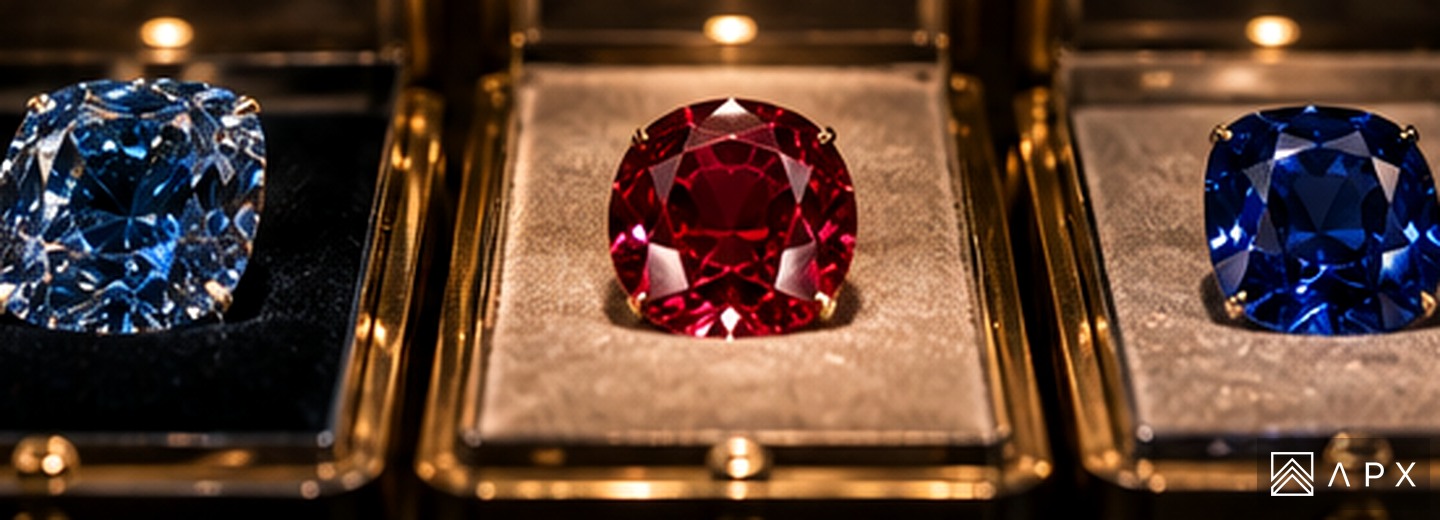
At $500k+, gemstones demand institutional-style due diligence. APX examines labs, treatments, brokers, auction houses, custody and exit planning.
Executive Summary
At US$500,000 and above, buying a diamond, ruby or sapphire is less like buying jewellery and more like underwriting a specialist asset. The buyer needs independent laboratory evidence, a defensible understanding of rarity, a view on market liquidity, and a custody and insurance plan before the stone changes hands.
The market can support extraordinary prices. In June 2026, Christie’s New York sold the 31.62-carat Azure Blue diamond for US$8.371 million and a 5.04-carat Fancy Vivid Blue diamond for US$8.127 million. Those results show the global appetite for exceptional colour, but they should not be extrapolated to ordinary stones. Trophy pricing is concentrated in a very small segment where size, colour, clarity, origin and rarity combine.
Key Takeaways
- For diamonds, independent grading is foundational; for coloured stones, laboratories focus on identification, treatment and, where possible, geographic origin.
- GIA explicitly says it does not “grade” sapphire or ruby in the same way it grades diamonds. Its coloured-stone reports identify characteristics, natural or laboratory origin, detectable treatments and sometimes geographic origin.
- For fine rubies and sapphires, confirmation of no heat or other material treatment can add significant rarity and value.
- White-diamond price benchmarks such as Rapaport can assist negotiation, but high-end coloured diamonds and gemstones remain bespoke markets.
- At $500k+, buyers should treat auction houses, dealers and brokers as sources of access — not substitutes for independent laboratory and legal due diligence.
Step One: Independent Laboratory Work
For a significant diamond, a current grading report from a recognised laboratory should be non-negotiable. For rubies, sapphires and emeralds, buyers need to understand what the laboratory actually says. GIA’s coloured-stone reports can identify the gem, detect treatments and, when possible, provide an origin opinion, but GIA does not issue a simple overall quality grade for sapphire or ruby.
Treatment is crucial. GIA notes that unheated fine-quality rubies and sapphires can command premiums because untreated material is rarer. Origin can also matter, though a famous origin alone does not guarantee quality.
Step Two: Understand the Selling Channel
UHNW buyers typically encounter stones through specialist dealers, auction houses such as Sotheby’s and Christie’s, or professional trade networks. For standard white diamonds, Rapaport provides pricing tools and a large dealer network.
Each route has different economics. Auctions provide transparent competition but charge buyer and seller fees. Dealers can source privately and discreetly but pricing is less visible. Trade networks can show live asking prices, but they are designed for professionals and still require expertise to judge the individual stone.
Step Three: Build the Exit Before the Entry
A $500,000 purchase should include an exit thesis. Which houses or dealers would be credible buyers in five or ten years? Is the stone sufficiently important to attract international auction interest? Is it portable across jurisdictions without creating import or tax problems? Is there an independent valuation history?
The best acquisitions often have several possible exit channels. A stone that only one dealer understands is much less liquid than a widely recognised natural fancy-coloured diamond or major untreated ruby with strong laboratory documentation.
Step Four: Custody, Insurance and Succession
Once acquired, the stone needs secure custody, transit cover and a documented valuation cycle. If it is mounted and worn, the family office should track when it leaves and returns to the vault. If it is loose, the lab report number and microscopic identifiers should be recorded alongside images and custody records.
Succession planning is often overlooked. Exceptional stones can be easy to divide physically but difficult to divide economically. Families should decide whether the next generation will inherit the stone, sell it, or hold it inside a trust or collection entity where appropriate.
APX Perspective
The best gemstones can behave like trophy art: scarce, globally collectible and capable of very high prices. But that does not make them a liquid commodity. At $500k+, the discipline should be closer to private-market due diligence than retail jewellery shopping. Laboratory evidence, provenance, acquisition channel, custody and exit planning matter as much as beauty.
Frequently Asked Questions
Does GIA grade rubies and sapphires?
GIA evaluates and identifies them but does not provide an overall quality grade like its diamond grading system. Its reports can describe the stone, identify treatments and provide an origin opinion when possible.
Are untreated rubies and sapphires worth more?
Fine stones with independent confirmation of no heat can command a premium because untreated examples are rarer, but colour, clarity, size and origin also matter.
Where do buyers find $500k+ stones?
Major auction houses, specialist dealers and professional trade networks are common channels. Independent laboratory verification and legal due diligence remain essential regardless of seller.
Related APX Intelligence
Sources & Further Reading
APX Intelligence is provided for general information only and does not constitute investment, legal, tax, financial or custody advice. Private banking, commodities, gemstones and alternative assets involve jurisdictional, liquidity, valuation, counterparty and regulatory risks. Independent professional advice and due diligence are essential.